
How Long Do Dental Implants Last? Lifespan, Crowns, and Care
A dental implant and the tooth attached to it don’t necessarily share the same lifespan. If you’re asking how long do dental implants last, the answer depends partly on which part you mean: the implant post is anchored in the jawbone, while the visible crown handles daily biting and chewing and may need attention sooner.
It’s understandable to want one clear estimate, especially when online answers differ. The key is to separate the longevity of the implant itself from that of its restoration. A crown may wear or become damaged even when the implant beneath it remains healthy, and an implant’s outlook varies from person to person.
This guide explains how the post, abutment, and crown differ, what can affect their longevity, and how daily care and follow-up may help protect your investment. You’ll also find practical points to discuss during an evaluation. Reston Family Dental Center provides dental implants and ongoing dental care to support your oral health over time.
Key Takeaways
- When considering how long do dental implants last, look separately at the implant post and the restoration attached to it.
- Healing, ongoing oral health, and individual habits can all shape an implant’s long-term outlook.
- A consistent home-care routine and regular dental visits help you maintain the implant and its restoration.
- A dental evaluation can assess the restoration, surrounding tissues, symptoms, and health history without promising a fixed lifespan.
How Long Do Dental Implants Last? Separate the Implant from the Crown
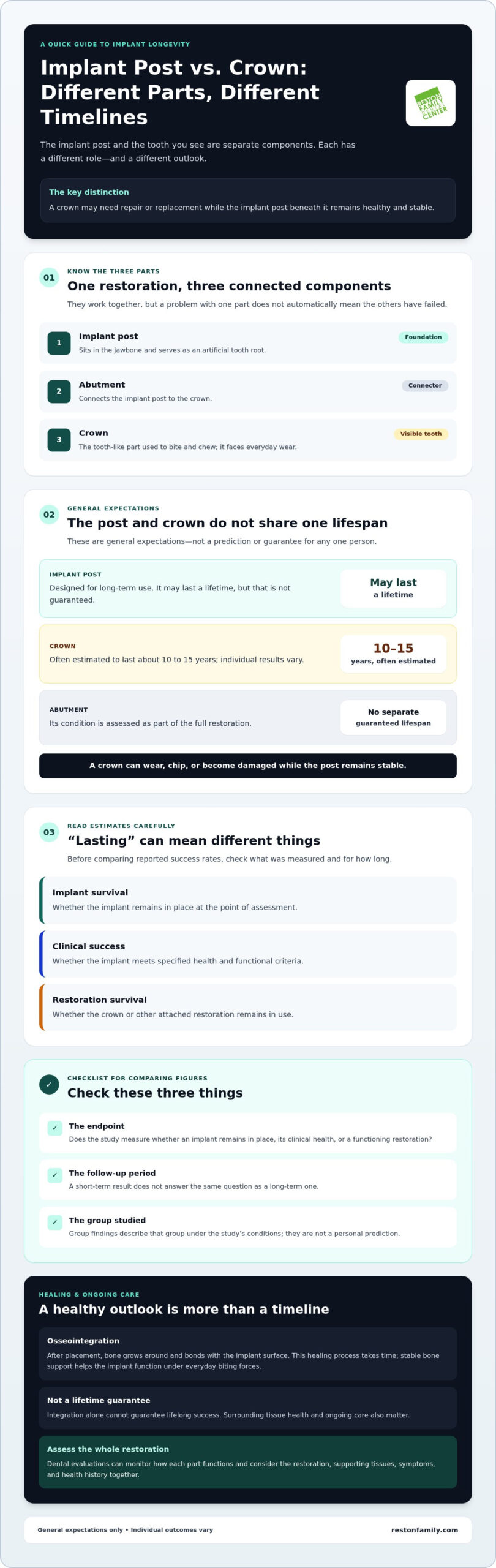
There isn’t one fixed answer to how long do dental implants last. The implant post and the restoration attached to it do different jobs, experience different types of wear, and may need attention at different times. The post is designed for long-term use and may last a lifetime, while the crown often needs replacement sooner. These are general expectations, not promises. Your outlook depends on your oral health, care, and individual circumstances.
What are the parts of a dental implant?
A dental implant restoration usually has three connected parts. The implant post sits in the jawbone and serves as an artificial tooth root. The abutment connects the post to the crown. The crown is the visible, tooth-like part used to bite and chew. This dental implant Wikipedia overview also describes the components and how they fit together.
Think of the post as the foundation, the abutment as the connector, and the crown as the part that replaces the visible tooth. They work together, but they are separate components. A problem with one doesn’t automatically mean the others have failed.
Typical lifespan estimates
- Implant post: Designed for long-term use; it may last a lifetime, but that isn’t guaranteed.
- Crown: Often estimated to last about 10 to 15 years, though individual results vary.
- Abutment: Connects the post and crown. Its condition is assessed as part of the full restoration rather than assigned a separate guaranteed lifespan.
These are general ranges and expectations, not a prediction for any one person.
Does the implant last as long as its crown?
Not necessarily. The post is anchored in the jawbone, while the crown is exposed to everyday chewing and can experience wear, chips, or other damage. The crown may need repair or replacement while the post remains stable. A dentist can assess the restoration and supporting tissues together to determine what needs attention.
Implant and crown longevity are separate outcomes: a crown may need replacement even when the implant post remains healthy. That distinction helps explain why lifespan estimates can seem to conflict. One estimate may refer to the post, while another describes the visible restoration.
“Designed to last” describes the intended role of the implant post, not a guarantee that it will last forever. Changes in oral health or the tissues around the implant can affect its long-term outlook. Similarly, a crown’s estimated lifespan doesn’t mean it will need replacement on a precise date. Regular dental evaluations help your dentist monitor how each part is functioning and discuss expectations based on your health and history.
Why Dental Implant Lifespan Estimates Vary
Estimates differ because “lasting” can describe different outcomes, and studies may measure different things over different periods. One report may count whether an implant remains in place; another may assess whether it meets clinical criteria for health and function. A crown’s condition is a separate question. When researching how long do dental implants last, check what an estimate measures before comparing it with another figure.
How does the implant bond with the jawbone?
After placement, the implant needs time to heal as bone grows around and bonds with its surface. This process, called osseointegration, isn’t an instant attachment. Stable bone support helps the implant function under everyday biting forces, but integration alone can’t guarantee lifelong success. The health of the surrounding tissues and ongoing care also matter.
The healing stage is one reason outcomes can’t be reduced to a single timeline. A study may follow implants from placement, while another may count only implants that reached a particular stage of healing. Patient health, follow-up duration, and the way researchers define an outcome can all shape the figures they report.
How should readers interpret implant success rates?
Read the outcome and timeframe together. Implant survival generally means the implant remains in place at the point of assessment. Clinical success refers to whether it meets specified health and functional criteria. Restoration survival concerns whether the crown or other attached restoration remains in use. An implant may remain in place but still need treatment, and a crown may need repair or replacement while the implant remains stable.
Success-rate figures depend on what researchers define as success and how long they follow patients. A percentage from a group study describes that group under the study’s conditions. It isn’t a personal prediction or a deadline for your implant. Even a carefully conducted study can’t account for every person’s health history, oral care, or changes over time.
- Check the endpoint: Does the study measure whether an implant remains in place, its clinical health, or a functioning restoration?
- Check the follow-up period: A short-term result doesn’t answer the same question as a long-term one.
- Keep the population in mind: Group findings can inform a discussion, but your dentist evaluates your circumstances individually.
For background on professional education and standards in implant dentistry, explore the American Board of Oral Implantology. For your own outlook, a dental evaluation can consider your implant, restoration, supporting tissues, and health history together. A personalized dental implant evaluation can help put general information in context and set realistic expectations without promising a fixed lifespan.
What Can Shorten a Dental Implant’s Lifespan?
There isn’t one single cause of implant complications. Oral health, daily habits, and personal medical factors can influence the tissues around an implant or the forces placed on its restoration. These factors may affect the outlook, but they don’t predict an individual outcome on their own. If you’re wondering how long do dental implants last, discussing your full health picture with your dental team is more useful than relying on a fixed estimate.
How can gum and bone health affect an implant?
The tissues and bone supporting an implant need attention even after healing. Plaque can irritate the gum around an implant. If inflammation persists or progresses, it may affect deeper supporting tissues and bone. This is called peri-implant disease. An implant can’t develop tooth decay like a natural tooth, but the surrounding gum and bone can still become unhealthy.
Inflammation doesn’t automatically mean an implant will fail. A dentist can assess the area and determine whether it needs care. Keeping gums healthy and attending dental visits helps the dental team monitor changes around the implant, including areas that may be difficult to see or clean at home.
Which habits and health factors deserve attention?
Some influences are part of everyday behavior; others call for a closer look at your personal history. Sharing these details helps your dental team plan care around your needs instead of assuming the same risks apply to everyone.
- Oral-health factors: A history of gum disease or difficulty keeping the area clean can affect the tissues around an implant. Ongoing inflammation deserves professional attention, but it isn’t by itself a diagnosis of implant failure.
- Habits and bite forces: Smoking can affect oral health and may influence the tissues around an implant. Teeth grinding can place extra force on the implant restoration. Neither habit means failure is certain, but both are worth discussing.
- Medical considerations: Conditions such as diabetes, changes in general health, and medications may be relevant to care planning. Their significance depends on the person and circumstances, so don’t stop or change medication without guidance from the prescribing clinician.
Bring an updated medication list to dental visits, and mention health changes since your last appointment. If you notice persistent redness, tenderness, swelling, bleeding, or a change in how the restoration feels, arrange an evaluation rather than trying to diagnose the cause yourself. These symptoms can have different explanations, and a dental examination can help clarify what’s happening.
Risk factors are prompts for a conversation, not a verdict on your implant’s future. Your dentist can consider your oral health, habits, medical history, and supporting tissues together. This individual review helps you understand which factors may be manageable and what follow-up makes sense for you.
How to Help Your Dental Implant Last Longer
Good home care and regular dental visits can help protect the tissues around an implant and keep its restoration under observation. An implant isn’t a natural tooth, but the crown and surrounding gum still need consistent cleaning. A practical routine also gives you a chance to notice changes and raise them early. These steps support oral health, but they can’t guarantee a specific lifespan or tell you exactly how long do dental implants last for you.
What daily care supports the tissues around an implant?
Clean the implant restoration as part of your usual oral-care routine. Plaque can collect around it, and the nearby gum and bone need attention even though the implant itself can’t develop tooth decay. Follow the brushing and between-teeth cleaning instructions your dental team provides. The right approach can depend on your restoration and individual needs, so ask for guidance if you’re unsure how to clean a particular area.
- Brush consistently. Clean your teeth and implant restoration as directed by your dental team, taking care to reach around the restoration.
- Clean between teeth. Use the interdental cleaning approach recommended for your mouth to help remove buildup near the implant and along the gumline.
- Follow your care plan. Keep to the recommendations you’ve received, and let your dental team know if a step is uncomfortable or difficult to manage.
- Keep dental visits. Routine evaluations and cleanings give your dentist an opportunity to assess the restoration and the tissues around it.
Consistency matters more than guessing at a special technique. If you’re not sure whether your routine reaches around the restoration effectively, ask your dental team to review it with you. Regular comprehensive preventative dental care in Reston can support monitoring as part of your broader oral-health needs.
When should you seek a dental evaluation?
Contact your dental team for an assessment if you notice new looseness, persistent discomfort, swelling, or drainage near the implant. Don’t wait for a routine visit if a change is ongoing or concerning. These signs don’t reveal the cause on their own. An examination can help determine what’s happening and whether the implant, restoration, or surrounding tissues need attention.
Pay attention to changes, but don’t try to diagnose them yourself. For example, a restoration that feels different may need an evaluation even if you’re unsure what has changed. Sharing when the symptom began and whether it’s getting better or worse can help your dentist understand the concern. Timely assessment doesn’t guarantee a particular outcome, but it can help identify an issue and guide appropriate care.
For questions about your implant’s condition and follow-up, explore dental implant care in Reston at Reston Family Dental Center. An evaluation can consider your restoration, supporting tissues, and oral-health history together.
Planning for Long-Term Dental Implant Care in Reston
Long-term implant care isn’t based on a calendar estimate alone. At a dental visit, your dentist can look at the restoration, the tissues supporting it, any symptoms you’ve noticed, and your health history together. This broader view helps distinguish a concern with the crown from changes around the implant and guides care to your individual needs.
What can a dentist assess during an implant visit?
An evaluation may include how the restoration looks and feels, whether it’s comfortable during everyday function, and the condition of the nearby gum and supporting tissues. Your dentist will also consider symptoms and relevant changes in your medical or dental history. Findings guide recommendations, which can vary from person to person. Follow-up can help identify concerns, but it can’t guarantee how long an implant or restoration will last.
Before your visit, note when you first noticed a change, whether it’s ongoing, and whether anything in your health or medication history has changed. Bring your questions, including how long do dental implants last in your particular situation. A personalized discussion can put general lifespan information in context without treating it as a promise.
For more background, Reston Family Dental Center’s complete dental implant guide in Reston can be a useful topic to explore alongside an individual evaluation. If you have an implant-supported denture, ask how its fit, comfort, and supporting tissues should be considered as part of your ongoing care. The practice also provides implant-supported dentures in Reston.
What is a practical next step for Reston-area patients?
If you notice a new symptom, a change in comfort, or have questions about your implant’s condition, arrange a dental evaluation. An examination gives your dentist an opportunity to consider what you’re experiencing alongside the restoration and surrounding tissues. It’s more useful than trying to predict a precise lifespan from general estimates.
Reston Family Dental Center provides dental implant and ongoing dental care for patients in Reston and nearby communities, including Great Falls, Ashburn, Chantilly, Herndon, and Vienna. Whether you’re looking for an assessment of an existing restoration or want to discuss long-term oral health, care can be guided by your findings and personal history. Follow-up supports monitoring and timely conversations, while recognizing that no visit can promise a specific outcome.
Questions about your implant deserve a thoughtful, individual conversation. An evaluation can help you understand your restoration and discuss appropriate follow-up.
Make Your Next Dental Visit a Chance to Plan Ahead
General information can help frame the question, but the most useful conversation is about your own mouth, health, and expectations. Before your next visit, jot down any changes you’ve noticed and the questions you’d like answered. You might ask what your current evaluation can tell you, what to keep an eye on, and how your care plan can adapt if your needs change.
That personal discussion is a practical next step after learning how long do dental implants last. It can replace guesswork with guidance tailored to your circumstances, while recognizing that no one can promise an exact lifespan. You deserve clear answers and a plan that feels manageable.
Frequently Asked Questions
Can dental implants get cavities?
No. An implant and its artificial crown can’t develop tooth decay because they don’t have natural enamel. However, plaque can build up around the restoration and irritate the gums or affect supporting tissues. Clean the area as part of your daily routine and maintain regular dental care. If a spot around the implant is difficult to reach, ask your dental team to review your cleaning approach.
Do dental implants need a root canal?
No. A dental implant is an artificial tooth root and doesn’t contain the living pulp found inside a natural tooth, so it can’t need a root canal. A natural tooth beside the implant can still develop a problem that requires treatment. If you feel pain near an implant, don’t assume which tooth or tissue is causing it. An examination can help identify the source and guide next steps.
Can I have an MRI with dental implants?
Often, people with dental implants can have an MRI, but compatibility depends on the specific implant material and device details. Before your scan, tell the imaging team that you have an implant and follow its screening instructions. Share any implant information you have. The imaging team or your clinician can assess your specific situation rather than relying on a general assumption about MRI safety.
Will a dental implant set off airport security?
Dental implants usually don’t cause an issue with airport screening, but equipment and individual circumstances vary. If security personnel ask about an implant or provide screening instructions, follow their directions. Don’t assume you’re exempt from screening because you have dental work. If you’re concerned about a particular trip, guidance from the relevant airport or security authority can help you prepare.
Is there an age limit for dental implants?
Age alone doesn’t determine whether dental implants are suitable. A dentist considers factors such as overall health, jaw development, bone support, oral health, and your ability to care for the restoration. Implant treatment is generally considered after jaw growth is complete, while older adults may still be assessed individually. A dental evaluation is needed to understand your circumstances; age by itself can’t establish eligibility.
Can a dental implant be placed after a tooth extraction?
Yes, an implant may be placed at the time of an extraction for some patients, while others need the area to heal first. Timing depends on factors such as the condition of the tooth site, bone and gum health, infection, and the overall treatment plan. Immediate placement isn’t suitable for everyone. If you’re planning an extraction or have recently had one, a dental evaluation can help determine timing for you.
Schedule a dental implant evaluation with Reston Family Dental Center to discuss your questions and plan your next steps.