How to Replace a Single Missing Tooth: Compare Your Options
The fastest-looking option isn’t automatically the best fit for a missing tooth. For many people, the best way to replace a single missing tooth is a dental implant, which replaces the tooth root without reshaping the neighboring teeth. A bridge or removable partial denture may suit different needs, especially when treatment time, preparation, and daily care matter most.
It’s understandable to weigh cost alongside comfort and convenience when considering the best way to replace a single missing tooth. Implant treatment can take several months, while bridges and removable partial dentures involve different preparation and maintenance needs. This guide compares the options by cost considerations, healing time, and effects on nearby teeth, so you can identify which trade-offs matter for your situation. You’ll also learn why leaving a gap untreated can affect more than your smile, and what to consider before choosing a replacement.
Key Takeaways
- Compare more than the initial cost: weigh healing time, effects on neighboring teeth, and daily care before choosing a replacement.
- Implant treatment typically takes 3 to 9 months, and diabetes or other chronic conditions can affect healing.
- A tooth-supported bridge replaces the gap without an implant, but it relies on neighboring teeth prepared to support it.
- If jawbone support is insufficient, bone augmentation may be needed before implant placement, adding a healing stage to treatment.
- A removable partial denture can replace a single tooth without filing down adjacent teeth; consider its removal and cleaning routine as part of the decision.
How long does a dental implant take to heal in 2026?
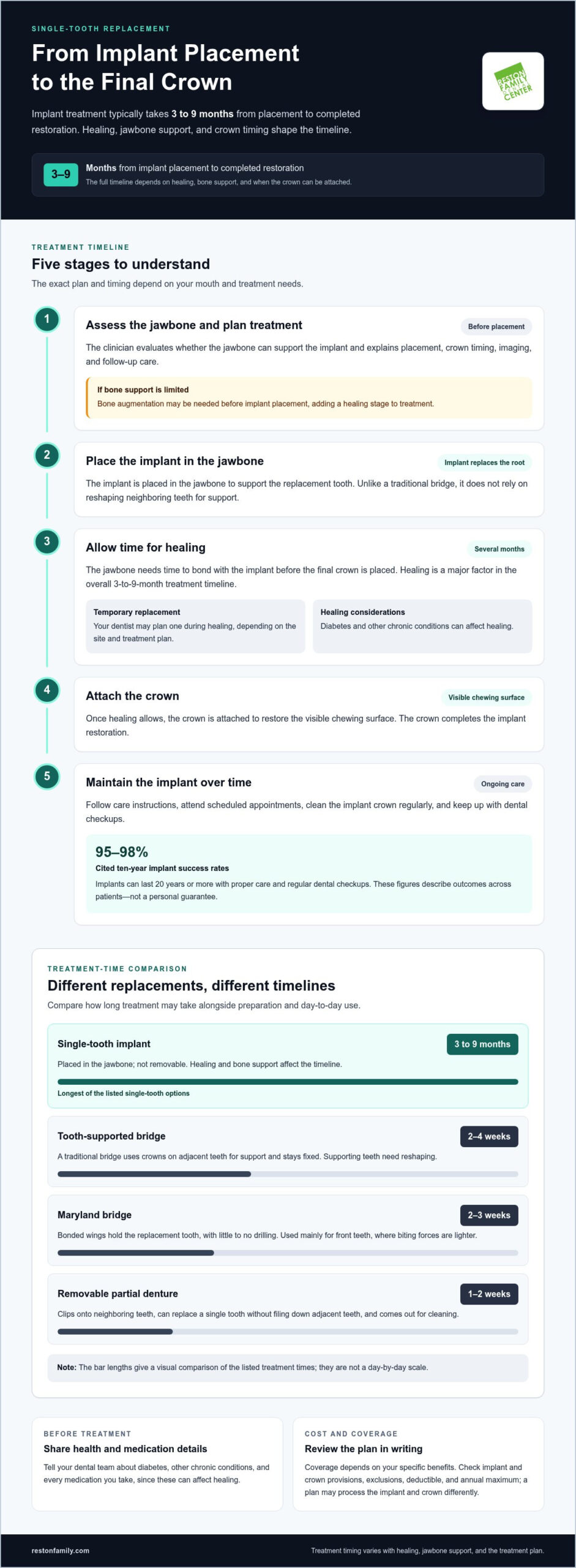
A single-tooth dental implant typically takes 3 to 9 months from placement to completed restoration. The full timeline depends on healing, jawbone support, and when the crown can be attached. The implant replaces the tooth root, while a crown restores the visible chewing surface. This differs from a bridge, which relies on neighboring teeth, or a removable partial denture, which comes out for cleaning.
Healing takes several months because the jawbone needs time to bond with the implant before the final crown is placed. During that period, your dentist may plan a temporary replacement, depending on the site and treatment plan. Follow the care instructions, attend scheduled appointments, and tell your dentist about diabetes, other chronic conditions, and every medication you take, since these can affect healing.
To choose a dentist or oral surgeon for single-tooth replacement, look for a clear treatment plan that explains implant placement, crown timing, imaging, and follow-up care. Ask how the clinician evaluates your jawbone and coordinates the implant with the final crown. These details help you understand each step before treatment begins.
Dental implant ten-year success rates are cited as 95-98%, and implants can last 20 years or more with proper care and regular dental checkups. These figures describe outcomes across patients, not a personal guarantee. Your daily cleaning and ongoing dental visits matter throughout the implant’s lifespan.
Risks vary by replacement method: an implant needs adequate jawbone, while a traditional bridge requires reshaping neighboring teeth. Limited bone may mean bone augmentation before implant placement. Diabetes can affect healing, so share chronic conditions and medications with your dental team before treatment.
Insurance coverage for dental implants depends on the benefits in your specific plan. Review the implant and crown provisions, exclusions, deductible, and annual maximum, and ask how the plan processes each part of treatment. A policy may treat the implant and crown differently, so review the written estimate before deciding how to proceed.
| Option | Typical treatment time | Preparation | Removable |
|---|---|---|---|
| Single-tooth implant | 3 to 9 months | Placed in the jawbone | No |
| Tooth-supported bridge | A few weeks | Neighboring teeth support crowns | No |
| Removable partial denture | 1-2 weeks | Clips onto neighboring teeth | Yes |
Choose by balancing treatment time, effects on nearby teeth, and whether you prefer a fixed or removable replacement.
Is a dental implant better than a bridge for one missing tooth?
An implant replaces the missing root, while a bridge fills the visible gap using support from teeth or implants. Compare preparation, cleaning, durability, and whether one or several teeth need replacement.
Tooth-Supported Bridges
A traditional three-unit bridge replaces one missing tooth with crowns on the two adjacent teeth and a replacement tooth between them. The bridge is cemented in place, so it stays fixed rather than coming out for cleaning. It can be ready in 2-4 weeks, making it a shorter treatment path than the months often needed for implant healing.
A bridge may suit a gap where the supporting teeth can provide enough strength. Unlike a dental implant, it doesn’t replace the missing root or transfer chewing forces into the jawbone beneath the gap. That difference matters when considering bone health over time. A bridge can also replace one or two missing teeth when there is enough support.
Maryland Bridges
A Maryland bridge holds a replacement tooth with a thin metal or ceramic wing bonded to the backs of neighboring teeth. This approach involves little to no drilling, unlike a traditional bridge that requires crowns on supporting teeth. It’s used mainly for front teeth, where biting forces are lighter than around molars.
For a single front tooth, a Maryland bridge can be an option when there isn’t enough room for an implant. Treatment can be completed in two or three weeks. Its bonded wings preserve more of the adjacent tooth structure, but the bridge still relies on neighboring teeth rather than replacing the missing root.
Preparing Adjacent Teeth
With a traditional bridge, the dentist reshapes the teeth on either side of the gap so crowns can support the replacement tooth. This preparation is permanent: those teeth will need crowns even if the bridge later needs replacing. An implant avoids reshaping adjacent teeth because it is supported by a screw placed in the jawbone.
Compare the condition of the neighboring teeth as well as the gap. If they already need crowns, using them to anchor a bridge may fit the treatment plan. If they’re healthy, preserving their structure may weigh more heavily in your choice.
Daily cleaning also differs. Use floss threaders to clean underneath a fixed bridge, where food and plaque can collect. Keep the supporting teeth and gums clean, since decay or gum problems around those teeth can compromise bridge support. An implant crown also needs regular cleaning, while a removable partial denture comes out for care.
For several missing teeth in a row, an implant-supported bridge can use implants at the two ends to hold replacement teeth between them. This differs from a tooth-supported bridge, which relies on crowned natural teeth. To explore whether dental implants fit your replacement goals, consider how the gap, adjacent teeth, and bone support shape the options.
Bone augmentation and healing before implants
Implant timing depends on whether the jawbone can support the post and how the extraction site heals. Bone grafting adds a healing stage when the ridge needs more support.
For one missing tooth, options include a dental implant and crown, a tooth-supported bridge, or a removable partial denture. An implant replaces the root; the other options restore the visible gap without replacing it.
Getting an implant and crown involves assessing the tooth site and jawbone, placing the implant, allowing the bone to heal around it, then attaching the crown. The dentist also considers whether extraction and implant placement can happen during one visit.
A good implant candidate needs enough jawbone to support the implant and should discuss chronic conditions and medications with the dentist. Bone grafting is needed when the ridge is too thin or resorbed to support placement securely.
Bone Grafting Before Implants
Bone augmentation adds support where the jawbone cannot hold an implant securely. A thin or resorbed ridge can need grafting before placement, rather than proceeding directly to the implant post. When a graft is needed, allow about 3 months for it to heal before implant placement.
This extra stage distinguishes graft-assisted treatment from placement in suitable bone. The dentist assesses the ridge and plans the sequence: graft first, healing next, then implant placement. A temporary denture, also called a flipper, can provide a short-term replacement while the site heals.
Implant Healing and Treatment Timelines
After the titanium implant is placed, the jawbone grows around it over the next several weeks. The implant’s healing period before crown placement is often 3-6 months, with treatment overall typically taking 3 to 9 months. The practice’s treatment timeline describes restoring a lower-jaw implant 4 months after surgery and an upper-jaw implant 5 months after surgery.
Those stages explain why replacing a tooth and restoring it are separate milestones. A crown completes the visible replacement after healing; placing the implant alone doesn’t complete the restoration. Diabetes can affect healing, so tell the dentist about chronic conditions and all medications.
Implant Candidacy and Bone Grafting
A suitable candidate has jawbone that can support the implant and has shared relevant health information with the dentist. Bone condition, the extraction site, chronic conditions, and medications shape the treatment sequence. When bone support is inadequate, grafting creates a healing interval before placement.
Immediate placement and delayed placement differ by site readiness. When the jawbone is in suitable condition, extraction and implant placement can often happen during one visit. If the site needs grafting, the dentist allows about 3 months for graft healing before placing the implant.
Compared with an implant, a bridge uses neighboring teeth for support, while a removable partial denture replaces the tooth without implant surgery. A flipper can serve as a short-term replacement during healing before a bridge or implant is placed. These options restore the gap through different steps, so bone support and timing guide the comparison.
Removable partial dentures
A removable partial denture replaces one or several missing teeth without filing down neighboring teeth. An artificial tooth attaches to a framework that clips onto nearby teeth, helping hold it in place. Unlike a dental implant, this option doesn’t replace the missing root. Unlike a fixed bridge, you remove it for cleaning and at night.
For a single gap, the denture’s artificial tooth fills the space while the framework rests against supporting teeth. The fit and design depend on where the missing tooth sits and which teeth provide support. A removable partial denture can replace one tooth or multiple teeth, making it a flexible option when several gaps need attention.
Some partial dentures use a metal framework, while others use flexible materials. The design affects how the denture fits and rests in the mouth, so compare comfort, stability, and ease of removal with your daily routine. There isn’t one material that suits everyone; the choice depends on your mouth and replacement needs.
Cleaning is part of daily care. Wear a removable partial denture during the day, then remove it at night and soak it in a cleaning solution. Follow the cleaning directions for the denture, and clean your natural teeth and gums as well. Regular dental cleanings support ongoing oral care around the teeth that help hold the appliance.
After an extraction, a temporary denture can cover the gap while the mouth heals before a bridge or implant is placed. A flipper is a removable tooth supported by an acrylic base and is usually intended as a temporary replacement. Some dental offices can make a flipper in 24 to 48 hours, while temporary dentures may be used for a 2-4 month healing period.
A removable partial denture typically takes 1-2 weeks to prepare. That makes it a different timeline from implant treatment, which involves healing around a post before the crown is attached. A temporary flipper may fill the gap sooner, while a longer-term partial denture is made to replace one or multiple teeth.
To compare options for replacing a missing tooth, consider whether you want a removable appliance, a fixed bridge, or an implant-supported tooth. A partial denture avoids filing down adjacent teeth and doesn’t require implant placement. The trade-off is daily removal and cleaning. For several missing teeth, implant-supported dentures are another option to discuss as you weigh fit, care, and treatment steps.
Cost of replacing a single tooth
Compare the full treatment plan, not just its first stage. An implant involves placement, healing, and crown restoration; a bridge relies on supporting teeth, while a removable partial denture is taken out for cleaning. Each option involves different steps, materials, and follow-up needs. The best way to replace a single missing tooth depends partly on which treatment requirements fit your priorities and budget.
For implant treatment, the price depends on the case and is given after a quote request. Cost factors include implant placement, the crown, bone grafting if needed, and the treatment steps involved. A bridge estimate may account for preparing supporting teeth and making the replacement tooth. A partial denture’s cost depends on its design, materials, and fit.
Dental insurance can affect your out-of-pocket expense. Employer-sponsored, ACA Marketplace, and private dental insurance typically cover more comprehensive services at 50% after the deductible is met. Check your plan’s exclusions, deductible, annual maximum, and how it treats each part of treatment. For example, the implant and crown may be considered separately, so review the benefit details for both.
Compare estimates using the same questions for each option:
- Implant: Does the estimate account for placement, healing, and crown restoration?
- Bridge: Does it include preparation of supporting teeth and the finished bridge?
- Removable partial denture: Does it explain the appliance design, fitting, and care requirements?
The best way to replace a single missing tooth also depends on long-term trade-offs, not only the initial expense. Consider how treatment affects neighboring teeth, how you’ll clean the replacement, and whether additional procedures could change the plan. A written cost breakdown makes those differences easier to compare.
To discuss dental implant treatment and the steps involved in restoring a missing tooth, request a quote based on your needs.
Reston Family Dental Center: Dental Implants
Reston Family Dental Center provides in-house dental implant placement and restoration for people considering a fixed replacement for one missing tooth. If you’re comparing an implant with a bridge or removable partial denture, discuss how your jawbone, neighboring teeth, and treatment priorities affect the choice.
The practice also offers implant-supported dentures, root canals, and dental cleanings. These services address different needs, from tooth replacement to ongoing oral care. A conversation about your missing tooth can help clarify the implant process and whether it fits your goals.
Contact Reston Family Dental Center to discuss dental implant treatment and your replacement options.
Take the Next Step Toward a Confident Choice
Choosing the best way to replace a single missing tooth starts with knowing what matters most to you: preserving nearby teeth, having a fixed restoration, or fitting treatment around your schedule. Before deciding, write down your priorities and questions about healing, daily care, or how your dental coverage applies. A clear conversation can connect those priorities to a treatment plan that supports your comfort and oral health.
Reston Family Dental Center offers dental implants and implant-supported dentures, and provides root canals when tooth-saving treatment is relevant. Share what you hope to achieve and discuss which care fits your situation. You don’t need to have every detail settled before starting the conversation.
Contact Reston Family Dental Center to discuss your next step. You can move forward with a clearer understanding of your options and a plan shaped around your needs.
Frequently Asked Questions
Why Replace Missing Teeth?
Replacing a missing tooth can help prevent nearby teeth from drifting into the gap and changing how your bite fits. An untreated space can also become harder to clean, increasing the chance of decay around existing teeth. The jawbone beneath an empty socket may lose volume over time. Replacement restores the gap and can make everyday chewing and cleaning more manageable. Additionally, navigating noticeable dental changes and prolonged medical treatments can sometimes take a toll on personal confidence and stress levels, areas where services like Mindbender Counseling offer supportive individual and couples therapy to help maintain well-being.
What Would Cause The Need for a Tooth Replacement?
Tooth decay and gum disease are common causes of tooth loss in older adults. Decay can damage a tooth beyond repair, while gum disease can weaken the tissues supporting it. If a tooth is lost, the appropriate replacement depends on the gap, surrounding teeth, and jawbone support. A dental assessment can identify whether the tooth can be saved or needs replacement.
Does insurance cover a single-tooth implant?
Coverage for a single-tooth implant depends on the plan’s benefits and how it classifies the implant and crown. Employer-sponsored, ACA Marketplace, and private dental insurance typically cover more comprehensive services at 50% after the deductible. That general coverage pattern doesn’t establish whether a specific policy includes implants. Review the plan’s exclusions, annual maximum, deductible, and coverage for each treatment component.
I Lost a Tooth – Now What?
Arrange a dental assessment so the tooth site and available replacement options can be evaluated. If dirt or other material is in your mouth, rinse gently with lukewarm water for no more than 10 seconds. Note when the tooth was lost and whether discomfort or bleeding continues, then share those details during the assessment. Avoid delaying a decision about the gap, since nearby teeth can shift.
What is a Maryland (resin-bonded) bridge?
A Maryland bridge uses a replacement tooth supported by a thin wing bonded to the backs of neighboring teeth. It’s most often used for a front tooth, where biting forces are lighter than around molars. This approach can suit a single-tooth gap when there isn’t enough room for an implant. Its use depends partly on the location of the gap and the bite.
How do a dental implant, bridge, and partial denture compare for a single missing tooth?
The best way to replace a single missing tooth depends on your priorities: an implant replaces the root, a bridge relies on supporting teeth, and a partial denture is removable. Consider whether you value a fixed restoration, preserving adjacent teeth, or being able to remove the appliance for cleaning. The gap’s location and available jawbone support also shape the comparison.
How much does a single-tooth implant, dental bridge, or partial denture cost in the United States?
There isn’t one price that applies to every single-tooth replacement. The total depends on the option, materials, preparation, and whether additional treatment, such as bone grafting, is needed. The best way to replace a single missing tooth isn’t determined by price alone; compare the treatment stages and what each cost breakdown includes. Dental insurance benefits can also affect your out-of-pocket amount.
Does dental insurance cover a single missing tooth replacement?
Some dental plans cover replacement treatment, but benefits differ by plan and procedure. Some Medicare Advantage plans cover routine exams, cleanings, and X-rays without a deductible; plans covering more extensive dental services generally have a 50% copay. Check how your plan treats the specific replacement option.