Dental Implant Consultation in Vienna, VA: Costs and Planning
An implant’s key difference is what supports the replacement tooth: it’s placed in the jawbone and doesn’t rely on neighboring teeth for support. A dental implant consultation in Vienna, VA, assesses whether this approach fits your oral health, bone structure, and goals. The evaluation may include digital X-rays, 3D imaging, and a review of your medical history.
If you’re weighing dental implants against a bridge or denture, it’s natural to consider comfort, function, and what treatment involves. A dental implant consultation is where those questions become a personalized plan, including an assessment of your candidacy and any preparatory care needed before placement.
Here, you’ll learn what to expect during the evaluation, how 3D imaging helps guide planning, and which factors can affect treatment costs. You’ll also find out how insurance coverage and financing considerations fit into the discussion, so you can approach your next steps with a clearer understanding of the process.
Key Takeaways
- Use the consultation to understand how your oral health, jawbone, and medical history shape implant candidacy.
- Learn how 3D imaging helps assess bone and plan implant placement around your anatomy.
- Ask how healing, any preparatory treatment, and the final restoration fit into your personalized treatment plan.
- Review the factors that affect your treatment estimate and how insurance coverage and financing may influence payment planning.
Consultation, candidacy, and 3D imaging
A dental implant consultation in Vienna, VA, connects your health history and jawbone anatomy to a practical treatment plan. The evaluation also considers whether preparatory care is needed.
Implant Candidacy and Bone Health
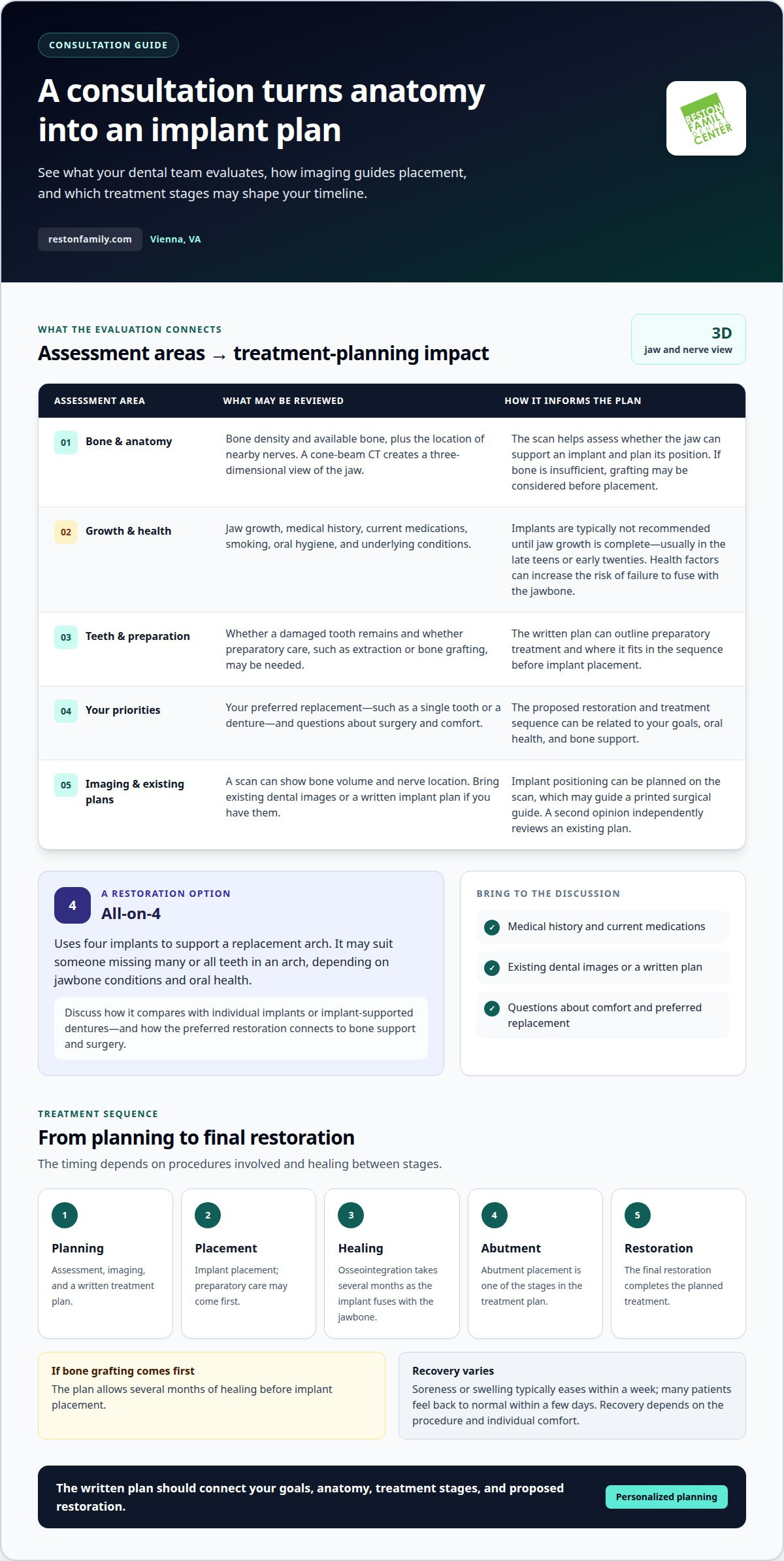
Bone density and overall health help determine whether your jaw can support an implant. A three-dimensional scan shows the available bone and the location of nearby nerves. If bone is insufficient, grafting may be considered before placement. Extraction may also be planned if a damaged tooth remains.
Jaw growth matters: implants are typically not recommended until growth is complete, usually in the late teens or early twenties. Smoking, poor oral hygiene, and underlying medical conditions can increase the risk of failure. Implants may fail if they do not fuse with the jawbone, so these factors inform candidacy.
Preparing for Consultation
Prepare a concise medical history, including underlying conditions and current medications, because your health history is part of the evaluation. Bring existing dental images or an implant plan to focus the discussion on your missing tooth or teeth.
At a dental implant consultation in Vienna, VA, share your concerns about surgery and comfort, along with your preferred replacement, such as a single tooth or a denture. These priorities help clarify what your treatment plan should address.
3D Imaging and a Second Opinion
A cone-beam CT creates a three-dimensional image of the jaw, showing bone volume and nerve location. Much like non-destructive examination methods used across industries by organizations such as internationaltestingservices.com to evaluate material integrity without causing damage, modern dental scans thoroughly assess underlying structures before surgery so the implant can be positioned accurately and guide a printed surgical guide.
A consultation evaluates your condition and develops a treatment plan; a second opinion independently reviews an existing plan. Bring the written plan and images to discuss specific recommendations.
All-on-4 Candidacy and Benefits
All-on-4 uses four implants to support a replacement arch. It may suit patients missing many or all teeth in an arch, depending on jawbone conditions and oral health.
Discuss how this approach compares with individual implants or implant-supported dentures. Your treatment plan should connect your preferred restoration with the bone support and surgery involved.
Dental implant consultation and personalized treatment planning
A personalized plan connects your oral health, preferred replacement, and implant placement sequence. Treatment typically progresses from planning to surgery, healing, and final restoration. Osseointegration takes several months as the implant fuses with the jawbone.
Written Treatment Options and Costs
A written plan helps you see how each proposed step relates to your goals. It can outline the restoration, preparatory treatment, and sequence of care, so you can understand what each option involves before deciding.
The cost depends on your case and is available upon consultation. Key factors include the number of implants, the type of restoration, and whether extraction or bone grafting is needed. Review the cost breakdown alongside the treatment stages, especially if you’re considering an implant-supported denture instead of replacing one tooth.
Treatment Stages and Healing
Implant treatment generally includes planning, implant placement, healing, abutment placement, and a final restoration. After placement, osseointegration takes several months. If bone grafting comes first, the plan allows several months of healing before implant placement.
These stages explain why replacing a missing tooth with an implant is not usually a single appointment. The schedule depends on the procedures involved and the healing needed between them. A clear plan identifies what happens at each stage and how the restoration completes treatment.
Risks, Complications, and Recovery
After surgery, patients can experience soreness, discomfort, and mild to moderate pain. Swelling or soreness typically eases within a week, while many patients feel back to normal within a few days. Recovery varies with the procedure and individual comfort.
A key complication is failure of the implant to fuse with the jawbone. Smoking, poor oral hygiene, and underlying medical conditions can increase the risk of failure. Discuss these factors during planning, including how they relate to your oral health and proposed treatment.
For a treatment discussion that connects implant placement with your planned restoration, explore dental implant treatment.
Implant costs, insurance, and financing
An implant estimate is easier to assess when the written plan separates surgery, restoration, and preparatory care. For example, replacing one missing tooth differs from planning a bridge or dentures supported by implants.
In Virginia, dental insurance coverage varies by plan. Ask your insurer which parts of treatment may be covered, including the implant, the restoration attached to it, and related procedures. A written cost breakdown can help you compare the proposed treatment with your plan’s benefits and identify potential out-of-pocket costs.
The cost depends on your case and is available upon consultation. Factors include the number of implants, the restoration selected, and whether extraction or bone grafting is part of treatment. A titanium implant post and its final restoration are distinct parts of the plan, so review what each cost breakdown includes.
At the consultation, written treatment options and cost breakdowns help show how different approaches address missing teeth. Compare the proposed steps, not just the total: a single implant, an implant-supported denture, and a bridge involve different restorations and treatment needs. Ask how each option fits your oral health goals and which components are included.
Monthly financing is a separate payment consideration from insurance coverage. If you’re evaluating a financing arrangement, compare the monthly payment, repayment period, and total amount owed. These details help you understand how payments fit your budget without confusing financing with what your insurance plan may reimburse.
For a practical review, organize the written cost breakdown alongside your insurance benefit information. Note which treatment stages appear in the estimate, what coverage your insurer describes, and which costs remain your responsibility. This side-by-side review can make it easier to discuss a realistic plan before treatment begins.
Dental implant consultation and evaluation
A focused evaluation connects your dental findings with the function you want from a replacement tooth. The appointment brings together imaging, medical history, and the dentist’s assessment before treatment is planned.
Consultation Expectations and Duration
An evaluation in Vienna may include digital X-rays, 3D imaging, and a medical history review. The dentist uses these details to assess your mouth and discuss how an implant could restore function. The appointment’s length depends on the assessments and discussion your case involves, rather than a fixed sequence for every patient.
An intraoral scanner can record your teeth without a tray or putty. The practice says its digital impressions are more accurate than a physical mold, giving the dentist another view of your dental structures. Together, these steps help shape the full evaluation, not just the site where an implant may be placed.
Questions to Ask
Use the appointment to clarify how the findings connect to your treatment plan. Ask what the imaging shows, which restoration is being considered, and how the proposed sequence supports your oral health.
- What did the digital X-rays and 3D images show about the planned site?
- Which treatment steps are included, and what determines their order?
- How will the final restoration support chewing and daily function?
- What findings could change the plan before an implant is placed?
If you already have a surgery plan from another dentist, a second opinion focuses on reviewing that proposal. Bring the written plan and available images so the discussion can address specific recommendations, such as placement or restoration choices.
For patients replacing one missing tooth, an implant is one option to discuss alongside the evaluation findings. A clear takeaway from the appointment is how your imaging, health history, and desired function relate to the proposed treatment, and which steps come next.
Schedule a dental implant evaluation to discuss your imaging and treatment needs.
Reston Family Dental Center: Dental Implants
Reston Family Dental Center provides dental implants and implant-supported dentures for patients exploring ways to replace missing teeth. If your evaluation has raised questions about which restoration may suit your needs, the practice can help you consider these options in light of your oral health and treatment goals.
A dental implant plan involves more than the replacement tooth. It includes assessing the proposed treatment and how the restoration will fit into your care. If a root canal or dental cleaning is relevant to your oral health, Reston Family Dental Center provides both.
Bring your questions about candidacy, treatment stages, insurance, and the written plan. Contact Reston Family Dental Center to discuss your dental implant needs.
Take the Next Step With a Clear Plan
The next step is turning your questions into a decision that reflects your priorities. Consider what matters most in daily life, whether that’s restoring comfortable chewing, replacing a visible missing tooth, or choosing a restoration that suits your needs. Use those priorities to guide a focused conversation, rather than feeling you need to decide on treatment before understanding your options.
A dental implant consultation in Vienna, VA, can move you from general research to a discussion grounded in your goals and oral health. Talk through what you want to restore, what remains unclear, and how the proposed care fits your circumstances. The conversation can also help you identify the questions you want answered before choosing a direction.
Reston Family Dental Center provides care including dental implants, implant-supported dentures, and root canals. If you’re ready to discuss your situation and possible next steps, contact Reston Family Dental Center. Take the conversation at your pace and move forward with greater clarity.
Frequently Asked Questions
Why are implants often preferred over bridges or dentures?
Implants can support a replacement tooth without relying on neighboring teeth, helping preserve the enamel of surrounding natural teeth. They can also support bridges or dentures when several teeth are missing. The right option depends on how many teeth need replacement and which restoration suits your oral health. Discuss those differences during your evaluation.
Are implants expensive?
The total cost depends on the treatment plan, including the restoration and any preparatory care. There isn’t one price that applies to every patient. A written cost breakdown helps you understand which treatment components are included, while your insurance plan determines whether any portion may be covered. For a useful comparison, review the proposed treatment and insurance benefits together.
Does implant surgery hurt?
Implant placement is surgery, and patients may experience soreness, discomfort, or mild to moderate pain afterward. The experience depends on the procedure and your comfort during recovery. Ask what recovery instructions apply to your planned treatment and which symptoms should prompt a follow-up conversation. This helps you prepare without assuming every procedure feels the same.
How do I choose the right implant dentist in Vienna, VA?
Consider whether your dentist can connect the evaluation, implant placement, and restoration in a clear plan. Reston Family Dental Center provides implant placement and restoration in-house, using tools including the Planmeca Pro Max CT system and iTero Lumina intraoral scanner. Patients from Vienna and nearby communities, including Reston, Great Falls, Ashburn, Chantilly, and Herndon, can discuss how these technologies support assessment and planning for their needs.
How long can an implant last once it is placed?
No single lifespan applies to every implant. Ongoing care supports the implant and artificial teeth, including daily brushing and flossing and regular dental checkups. Keep routine examinations as part of your oral health care, and mention changes in comfort or function during visits. These habits help the dental team monitor your restoration over time.
How long does the whole implant process take?
Completing implant placement through final restoration generally takes several months because healing and integration need time. The schedule also depends on whether preparatory care, such as bone grafting, is part of your treatment. Ask which stage comes next and what must heal before it can begin; that gives you a more useful timeline than focusing on the placement appointment alone.