Full Arch Dental Implants in Chantilly: A Patient’s Buying Guide
The most fixed-feeling full-arch option isn’t automatically the right fit for every patient. If you’re researching full arch dental implants Chantilly, it’s natural to wonder whether a fixed restoration or an implant-supported denture will feel comfortable, involve a manageable recovery, and suit your oral health.
Those questions matter because full-arch treatment involves a series of decisions, not a one-size-fits-all solution. The right approach starts with the restoration you need, then takes your clinical findings and personal priorities into account. Bone support, overall health, comfort preferences, and treatment goals can all shape the plan.
This guide compares the main implant-supported full-arch options and outlines factors that may influence candidacy, treatment steps, and healing. You’ll also find practical questions to discuss with a dental team serving Chantilly, Reston, Great Falls, Ashburn, Herndon, and Vienna. Reston Family Dental Center provides dental implants and implant-supported dentures, with individualized planning to help connect restorative options to your needs.
Key Takeaways
- A full-arch restoration replaces a complete upper or lower row of teeth. The right option depends on the restoration you need and your clinical findings.
- Compare fixed and removable implant-supported restorations by how they’re worn, maintained, and managed in daily life.
- Use a practical checklist to understand how your oral health, anatomy, and preferences can shape a treatment recommendation for full arch dental implants Chantilly.
- Prepare for a four-step planning conversation: consultation, examination, treatment discussion, and agreed next steps.
- Reston Family Dental Center provides dental implant and implant-supported denture care for patients in Chantilly and nearby communities.
Full Arch Dental Implants in Chantilly: What Does the Treatment Restore?
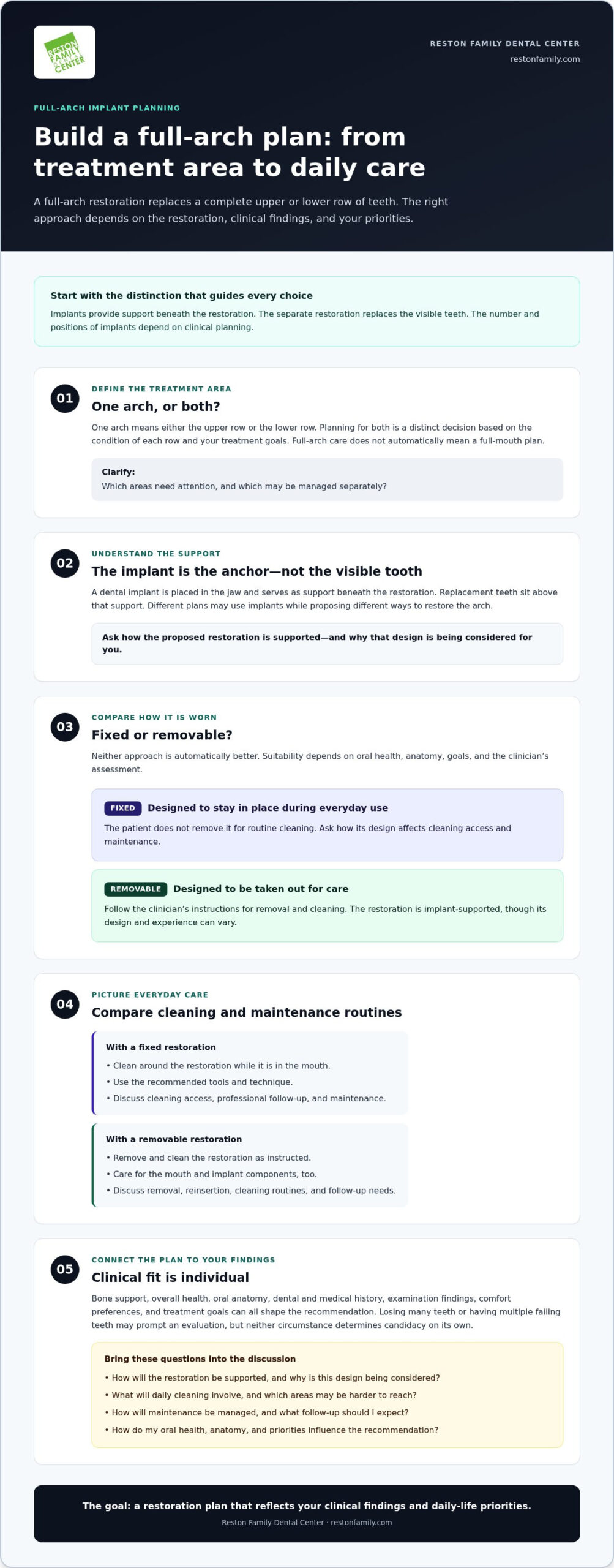
Replacing most or all of your teeth is a major decision, and dental terminology can make the first steps feel less clear than they need to be. Start with one distinction: implants provide support, while a separate restoration replaces the visible teeth. Understanding how those parts work together can help you discuss whether treatment for one arch or both belongs in your plan.
A full-arch restoration replaces a complete upper or lower row of teeth. The term describes the span being restored, not one specific device. As this overview of full arch restoration explains, full-arch care can involve different restoration approaches. The clinical plan determines how the replacement teeth are supported and designed to fit your needs.
One arch means either the upper row or the lower row. You may need to discuss one arch if the other is being managed separately. Planning for both is a distinct decision based on the condition of each row and your overall treatment goals. Full arch dental implants Chantilly patients explore don’t automatically mean a full-mouth plan. An evaluation helps identify which areas need attention and which options may be appropriate.
How implant support and replacement teeth work together
A dental implant is placed in the jaw and serves as an anchor beneath the restoration. The replacement teeth sit above that support, restoring the visible row. In plain terms, the implant isn’t the tooth you see; it helps hold the restoration in place. The number and positions of implants depend on clinical planning, including an assessment of your mouth and the restoration being considered.
When patients begin exploring a full-arch solution
Consider what you want the discussion to clarify: whether one arch or both need treatment, what type of restoration is being considered, and how it would be supported and maintained. Bring questions about comfort and daily care, too. These specific questions can turn a broad concern into practical next steps without presuming that the same solution fits every patient.
Fixed or Removable Full-Arch Implants: Compare the Restoration Options
Once you know which arch needs attention, the next question is how you want the replacement teeth to be worn and cared for. Broadly, implant-supported full-arch restorations may be fixed or designed for removal. Neither approach is automatically better. Suitability depends on your oral health, anatomy, goals, and the clinician’s assessment.
| Consideration | Fixed restoration | Removable implant-supported restoration |
|---|---|---|
| How it’s worn | Designed to stay in place during everyday use. | Designed to be taken out for care, following the clinician’s instructions. |
| Daily cleaning | Clean around the restoration while it’s in the mouth, using the recommended tools and technique. | Remove and clean the restoration as instructed, while also caring for the mouth and implant components. |
| Maintenance discussion | Ask about cleaning access, professional follow-up, and how maintenance is handled. | Discuss removal and reinsertion, cleaning routines, and follow-up needs. |
What a fixed full-arch restoration means
A fixed restoration is designed to remain in place during everyday use rather than being removed by the patient for routine cleaning. That shapes your daily care routine: you’ll need to understand how to clean around it and what follow-up is recommended. Ask how its design affects access for cleaning and maintenance, and what to do if something feels different. Your clinician can explain the care expected for your specific plan.
How an implant-supported removable option differs
Some implant-supported restorations are designed to be removed for cleaning and care. Unlike a conventional removable denture, this type is supported by implants, though the precise design and experience vary. Discuss how you’ll remove and reinsert it, how to clean both the restoration and your mouth, and what maintenance it may require. The practice’s guide, “Secure Your Smile: The Complete Guide to Implant-Supported Dentures in Reston,” offers further context on this restoration category.
As you compare full arch dental implants Chantilly options, focus on the questions that affect daily life as well as clinical fit:
- How will the restoration be supported, and why is that design being considered for me?
- What will daily cleaning involve, and which areas may be harder to reach?
- How is maintenance managed, and what follow-up should I expect?
- How do my oral health, anatomy, and personal priorities influence the recommendation?
The answers should connect the proposed restoration to your individual findings, not to a blanket claim that one style suits everyone. For general dental-health information, the National Institute of Dental and Craniofacial Research provides a helpful government resource. You can also explore dental implants and implant-supported dentures to learn more about these treatment categories.
How to Evaluate Full-Arch Dental Implant Options in Chantilly
A useful treatment comparison goes beyond choosing a restoration style. It should explain how the proposed option relates to your examination findings, what care it involves, and how the plan fits your priorities. As you consider full arch dental implants Chantilly, focus on the reasoning behind each recommendation rather than trying to rank approaches in the abstract.
A full-arch plan should be tailored to your clinical findings because oral health, anatomy, and restoration goals differ from patient to patient. A recommendation should identify the restoration being considered and explain how your health and the condition of your mouth inform the plan. If the explanation is unclear, ask how the findings connect to the recommended design.
Clinical findings that can shape the recommendation
An evaluation may consider the health of your gums and remaining teeth, how your bite fits together, and the supporting anatomy available for a restoration. These factors help the clinician understand what needs attention and which options may be appropriate. Imaging may also inform planning when the clinician determines it’s appropriate; the need and type depend on the individual assessment. A description of tooth loss or discomfort alone can’t establish candidacy or predict an outcome.
Questions that make a treatment comparison clearer
Bring a short list to your appointment and take notes as the clinician explains the options. Clear answers can help you understand both what is proposed and why it may suit your needs.
- Restoration: What type of restoration are you proposing, and how does it relate to my goals and clinical findings?
- Care: How should I clean and maintain it at home, and what follow-up care should I plan for?
- Appointments: What are the expected stages and visits, and what might affect their sequence?
- Additional procedures: Could anything else be recommended based on my examination, and what would that address?
- Plan changes: If new findings affect the plan, how will the options and reasons be explained before we proceed?
- Cost: What parts of the proposed treatment contribute to my individualized cost, and what does the estimate include?
Cost is a planning question, not a reliable way to compare two plans without understanding what each includes. Ask for the proposed restoration, appointments, maintenance expectations, and any possible additional procedures to be explained together. That gives you a clearer basis for considering the overall commitment instead of focusing on one detail in isolation.
For more background on implant treatment, the practice’s guide, “Restoring Confidence with Dental Implants in Reston, VA: Your Complete Guide,” can complement the questions you bring to a clinical discussion. You don’t need to decide everything in advance. Aim to leave with a clearer understanding of the recommendation, the factors behind it, and the next steps that feel right for you.
Full-Arch Implant Candidacy and Planning for Chantilly-Area Patients
Planning starts with understanding your health, current dental concerns, and what you hope a restoration will help you do. There isn’t a single checklist that can determine candidacy on its own. For patients exploring full arch dental implants Chantilly, a clinician considers the full picture and explains how findings and preferences inform the available options. Timing and any additional procedures also depend on your individual assessment.
The process can be organized into four steps:
- Consultation: Share your concerns, dental history, medical history, and goals for restoring your teeth.
- Examination: The clinician assesses your oral health and gathers the information needed to understand your individual case. Imaging may be used when appropriate.
- Treatment discussion: Review possible restoration approaches, relevant clinical findings, practical considerations, and follow-up needs.
- Agreed next steps: Decide together what should happen next, including any further assessment or planning needed before treatment decisions are made.
What the initial clinical assessment is intended to clarify
Your dental history can explain previous treatment and current concerns, while your medical history gives the clinician context about health factors relevant to care. Be ready to describe what you’d like your restoration to address, whether that’s replacing a row of teeth or understanding the choices available. An examination, along with imaging when the clinician considers it appropriate, helps build a clearer picture. Your description is a useful starting point, but it can’t replace a clinical assessment.
Share information as accurately as you can, including medications and known health conditions. If you’re unsure whether a detail matters, mention it. The care team can consider your history and examination together to discuss the factors that apply to you, without making assumptions based on one symptom or detail.
How a patient-centered treatment plan takes shape
A tailored plan connects your clinical findings with your preferences. The care team can explain the restoration being considered, why it may fit the assessment, and what practical steps and follow-up may involve. Timing isn’t identical for everyone, and additional procedures may or may not be part of an individual plan. Ask what each proposed step is intended to address and what could change the sequence.
Comfort questions belong in the conversation, too. Tell the clinician what concerns you about treatment, recovery, or day-to-day care. You can also ask how changes to the plan would be discussed and what decisions need to be made before moving forward. For added background on the surgical process, the guide “The Step-by-Step Guide to Dental Implant Surgery” offers another point of reference.
A thoughtful planning conversation should leave you with a clearer understanding of your options, not pressure to choose immediately. If you’re ready to discuss your restorative goals with a local dental team, schedule a dental implant discussion with Reston Family Dental Center.
Explore Full-Arch Dental Implant Care Near Chantilly
Choosing where to discuss a full-arch restoration is personal. You want a local team that will listen to what matters to you, review your oral health, and explain options clearly. Reston Family Dental Center provides dental implants and implant-supported dentures as part of its restorative care for patients in Chantilly, Reston, Great Falls, Ashburn, Herndon, and Vienna.
Your first visit is an opportunity to talk through your goals and concerns, review relevant clinical findings, and learn which options may be appropriate for your situation. If you’re considering full arch dental implants Chantilly, you don’t need to arrive with a decision already made. A focused conversation can help you understand what the assessment suggests and which questions to consider next.
What to bring to a full-arch consultation
A little preparation can help you make the most of the discussion. Bring information that gives the dental team a useful picture of your health and what you hope to address. If you don’t have every record on hand, share what you can and note anything you’d like help clarifying.
- Medication list: Bring a current list of prescriptions and other medications you take.
- Health and dental history: Note relevant medical conditions, past dental treatment, and current concerns.
- Questions and goals: Write down what you want a restoration to help you do, along with questions about comfort, care, or the steps involved.
- Existing records: Bring prior dental imaging or records if they’re available.
For example, note that you want to understand how a removable option would be cared for, or ask what information the examination will clarify. Writing down questions can make it easier to cover what matters to you during the appointment.
A clear next step for Chantilly patients
Treatment discussions should make room for your preferences and concerns. Ask the team to explain unfamiliar terms, describe the purpose of a proposed step, and clarify what follow-up may involve. Clinical findings guide the discussion, while your priorities help shape which options deserve attention. Your conversation should address the questions that matter to you.
Restorative planning is a process of understanding your needs and considering appropriate options together. You can begin with questions, even if you’re still deciding what you want from treatment. An initial conversation is a practical way to share what’s concerning you and learn what the next steps may involve.
Ready to discuss your full-arch restorative needs with Reston Family Dental Center? Schedule a conversation about dental implants.
Take the Next Step With Confidence
You don’t need to settle every detail before starting a conversation. Bring your questions, priorities, and any concerns you’re weighing. That gives your dental team a starting point for discussing what matters most and explaining how clinical findings can inform a plan. For full arch dental implants Chantilly, a clear conversation can help turn uncertainty into practical questions and a more confident way forward.
Consider what you’d most like to understand first: the restoration options, the planning process, or how treatment could fit your daily needs. Raise one concern at a time and ask for explanations in language that feels clear. Your next step should feel informed, personal, and guided by your needs.
Schedule a consultation with Reston Family Dental Center to discuss your questions and restorative goals.
Frequently Asked Questions
Am I too old for full-arch dental implants?
Age alone doesn’t determine whether full-arch implants may be appropriate. A clinician considers your overall health, oral condition, medications, and other factors that can affect treatment and healing. If you’re older and exploring tooth replacement, bring your health history and questions to an evaluation. The discussion can focus on your individual circumstances and goals rather than age as a standalone measure.
How much do full-arch dental implants cost in Chantilly?
The cost of full arch dental implants in Chantilly depends on the treatment plan, so an individualized estimate is needed rather than relying on a general figure. The restoration selected, clinical findings, and any additional care can affect what’s included. Ask for a written breakdown of the proposed treatment and which services it covers. You can also review your dental plan’s benefits to understand how coverage may apply.
How long does full-arch dental implant treatment take?
Treatment often takes several months, but the schedule depends on your clinical needs and the steps in your plan. After implant placement, healing before the final restoration is attached commonly takes three to six months. Additional procedures or healing needs may affect the sequence. Ask your clinician to explain the anticipated stages, what determines when you move forward, and how the schedule will be reviewed as treatment progresses.
Can I choose between fixed and removable full-arch teeth?
You can discuss both fixed and removable implant-supported restorations, but the options appropriate for you depend on your clinical assessment. Your daily preferences matter: for example, consider whether you value a restoration designed to stay in place or prefer one designed to be removed for care. Ask your clinician to explain the advantages, care routine, and clinical considerations of each option in your case.
What if I have been missing teeth for a long time?
Having missing teeth for a long time doesn’t automatically rule out implant treatment, but the condition of your mouth needs to be assessed. Changes in the jaw or remaining teeth may influence which options are appropriate. Share when teeth were lost, any prior treatment, and relevant records with the dental team. An examination, and imaging if appropriate, can help clarify what your individual plan may involve.
Can full-arch dental implants be covered by dental insurance?
Coverage varies by dental plan, and benefits for implants or restorations may be limited by exclusions, waiting periods, or annual maximums. Before treatment, ask your insurer how your specific plan handles implant placement and the replacement teeth, and request a written estimate of benefits if available. Remember that an estimate isn’t a guarantee of payment. Your dental team can help you understand the treatment details to review with your insurer.
Do I need a consultation before deciding on full-arch implants?
Yes. A consultation and clinical assessment are important before deciding, because your oral health, medical history, and goals help shape the discussion. Bring a medication list, notes about your concerns, and prior dental records or imaging if available. Patients from Reston, Great Falls, Ashburn, Chantilly, Herndon, and Vienna can use the visit to ask questions and understand possible next steps without committing to a treatment decision.