
Same-Day Crown vs. Traditional Crown: Which Is Right for You?
The faster crown isn’t automatically the better choice, and a traditional crown isn’t automatically more durable. If you’re weighing same day crown vs traditional crown, the right fit depends on the tooth being restored and your dentist’s treatment plan, not just how many visits the process takes.
It’s reasonable to wonder whether a crown made in less time can fit comfortably and hold up well. Both approaches are designed to restore a damaged tooth, but the steps, timing, and available options can differ. Your tooth’s condition, location, bite, and individual needs help determine which approach may be appropriate.
This guide explains how same-day and traditional crowns are made and placed, which clinical and practical factors can shape your options, and what to ask before deciding. Reston Family Dental Center offers same-day dental crowns and restorative care in Reston. An in-person assessment is needed to determine whether same-day treatment suits your tooth. Patients in Reston, Great Falls, Ashburn, Chantilly, Herndon, and Vienna can use these questions to prepare for a conversation with a local dentist.
Key Takeaways
- Compare same day crown vs traditional crown by considering your tooth’s needs and treatment plan, not appointment count alone.
- Learn how the process and waiting time can vary, and why available crown materials depend on your case.
- Understand how fit, bite, and material can influence how a crown performs over time.
- Use a simple discussion framework to review your tooth, options, timing, and follow-up with your dentist.
- An in-person assessment can help determine whether same-day treatment is suitable for you at a Reston practice.
Same-Day Crown vs. Traditional Crown: What Is the Difference?
Choosing between a same-day crown and a traditional crown means weighing convenience against what’s clinically suitable for your tooth. A shorter process can be appealing, but appointment count alone doesn’t determine the right approach. Your dentist first needs to assess the tooth and the treatment it requires.
A dental crown is a custom-made covering placed over a tooth to restore its shape and protect it when it’s damaged or weakened. A dental crown can be made using different processes and materials, depending on the dentist’s approach and your treatment plan.
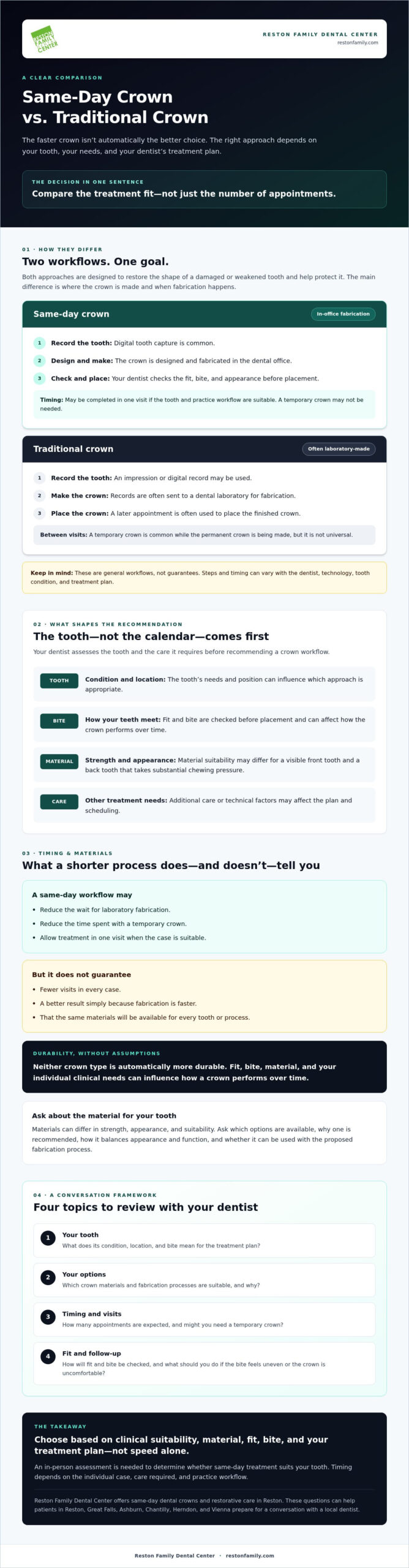
The main process difference is where the crown is made and whether fabrication happens during the preparation appointment or between visits.
| Process detail | Same-day crown | Traditional crown |
|---|---|---|
| Tooth records | Digital tooth capture is common | Impressions or digital records may be used |
| Fabrication | Designed and made in the dental office | Often fabricated by a dental laboratory |
| Visits and temporary crown | May be completed in one visit if suitable; a temporary crown may not be needed | Often involves a preparation visit and a later placement visit; a temporary crown is common between visits, but not universal |
These are general workflows, not guarantees. The exact steps and timing can vary with the dentist, available technology, tooth condition, and treatment plan.
How does a same-day crown appointment usually work?
In a common workflow, the dentist prepares the tooth and captures its shape digitally. The crown is then designed and fabricated in the office. Before placement, the dentist checks its fit, how it meets your bite, and how it looks alongside nearby teeth. Whether the process can be completed during one visit depends on the clinical assessment and the practice’s workflow.
How is a traditional crown made and placed?
For a traditional crown, the dentist records the prepared tooth with an impression or digital scan and may send those records to a dental laboratory for fabrication. A temporary crown is commonly placed to cover the tooth while the permanent one is being made, although the steps can differ. Timing depends on the practice, laboratory, and your treatment plan.
In the same day crown vs traditional crown comparison, the key distinction is typically in-office fabrication during the preparation visit versus laboratory fabrication between appointments. Your dentist can explain which workflow is appropriate for your tooth.
How the Crown Process, Materials, and Visits Can Differ
The workflow is only one part of choosing a crown. Material selection, the tooth’s condition, and any additional care needed can all affect what your dentist recommends. Digital production may reduce the wait for a laboratory-made crown, but neither fabrication method guarantees a better result by itself.
With either approach, the dentist examines and prepares the tooth, and may use local anesthesia to keep you comfortable. Before the crown is placed, they check its fit and how your teeth meet when you bite. Ask how to care for the restored tooth and what to do if your bite feels uneven or the crown feels uncomfortable.
What should patients know about crown materials?
Materials can differ in strength, appearance, and suitability for a particular tooth. A visible front tooth may raise different appearance considerations than a back tooth that takes substantial chewing pressure. Your overall clinical needs matter, too. The durable crown materials overview from Cleveland Clinic describes common options and their characteristics, but the materials available to you depend on your dentist and treatment plan.
Ask which materials are available for your tooth and why one is recommended. Find out how the choice balances appearance and function, and whether the material can be used with the proposed fabrication process. There isn’t one option that suits every patient.
Does one crown process always take fewer visits?
A same-day workflow may reduce the wait for laboratory fabrication and the time you spend with a temporary crown. But fewer visits aren’t guaranteed. The initial examination may identify other treatment needs, and clinical or technical factors can affect scheduling. A traditional crown may involve a wait while a laboratory makes it, with appointment timing varying by practice and case.
Treatment timing depends on the individual case, the care required, and the practice’s workflow. If you’re comparing same day crown vs traditional crown, ask how many appointments your treatment is expected to involve, whether a temporary crown is planned, and what might change the schedule.
An in-person assessment can clarify which approach and materials are appropriate. If you’re in Reston or nearby Great Falls, Ashburn, Chantilly, Herndon, or Vienna, you can learn more about same-day dental crowns and restorative care from Reston Family Dental Center and discuss whether same-day treatment may suit your tooth.
Is a Same-Day Crown as Durable as a Traditional Crown?
A crown made more quickly isn’t automatically lower quality. Fabrication time alone doesn’t determine how well a crown fits or performs. The result depends on the full treatment, including the tooth’s condition, the material selected, and how carefully the crown is checked against your bite.
Both same-day and traditional approaches have potential advantages and case-specific limitations. A same-day process may be convenient and reduce the time you spend with a temporary crown. A laboratory-made crown may give your dentist access to options shaped by the laboratory’s capabilities and the clinical plan. Neither route is inherently right for every tooth. Ask how the proposed crown addresses your needs and what factors could affect its performance.
What factors can influence crown longevity?
Daily care and the forces placed on a crown matter, regardless of how it was made. Keeping up with oral hygiene and recommended dental follow-up gives your dentist a chance to monitor the crown and surrounding tooth. The tooth’s condition before treatment and how the crown meets opposing teeth can also be relevant.
If you grind or clench your teeth, mention it during your evaluation. Those habits can affect the forces on a crown, and your dentist can consider them when discussing treatment. The traditional crown procedure may involve more than one appointment, but that schedule alone doesn’t establish how a particular crown will perform over time.
What are the practical trade-offs of each approach?
Same-day fabrication may reduce laboratory waiting and the period spent wearing a temporary crown. That convenience is useful only if the approach suits the tooth and treatment plan. The dentist’s assessment may identify clinical or practical reasons to use a different workflow.
With traditional fabrication, a dental laboratory may make the crown between appointments. Available materials and design options depend on the dentist, laboratory, and requirements of your case. Ask which options are available, why your dentist recommends one, how the crown’s fit and bite will be assessed, and what follow-up to expect.
In the same day crown vs traditional crown decision, appointment convenience and an individual prognosis are separate questions. A faster workflow may change the treatment schedule, but your dentist must assess your tooth and treatment needs to discuss expected performance. For a local conversation about your options, ask Reston Family Dental Center about crown options.
Choosing the Best Crown Option With Your Dentist
A clear decision starts with your tooth, not your calendar. The same day crown vs traditional crown choice should follow an examination of the tooth and your oral-health needs. Convenience matters, but it shouldn’t replace the dentist’s clinical recommendation. Use this framework to guide the conversation:
- Assess the tooth. Discuss the extent of damage, its location, and whether other treatment may be needed before it’s restored.
- Review the options. Ask which fabrication routes and crown materials are available for this tooth, and why your dentist recommends one.
- Discuss timing. Clarify what the proposed visits involve, whether a temporary crown may be needed, and what could affect the schedule.
- Clarify follow-up. Ask how the dentist will check your bite, whether an adjustment might be needed, and what care instructions to follow afterward.
Regular exams and preventive care can also help your dentist understand your overall oral health when planning treatment. Learn more about preventative dental care and regular exams.
Which questions should you ask before treatment?
Ask why a particular fabrication route is recommended for your tooth, what each visit includes, and whether a temporary restoration is part of the plan. You can also ask how the dentist will assess the crown’s fit and bite, what follow-up to expect, and whom to contact if it feels uncomfortable afterward. These details help you compare the full treatment experience, not just how quickly the crown is made.
When does the tooth itself affect the decision?
The extent of damage, the tooth’s position, and other treatment needs may influence which options are appropriate. A dentist can evaluate these factors in person and explain the reasoning behind a recommendation. An online comparison can’t confirm your individual suitability. If your discussion involves replacing a missing tooth with an implant-supported restoration, this dental implant treatment guide offers related context.
At Reston Family Dental Center, an in-person assessment can help determine whether same-day crown treatment suits your needs. Discuss your crown options with Reston Family Dental Center.
Discuss Same-Day and Traditional Crowns With a Reston Dentist
The best choice depends on more than how quickly a crown can be made. Compare clinical suitability, treatment steps, and convenience with a dentist who can examine the tooth and explain your options. Reston Family Dental Center offers same-day dental crowns and restorative care in Reston, but an assessment is needed to determine whether same-day treatment is appropriate for your situation. Patients from Great Falls, Ashburn, Chantilly, Herndon, and Vienna can also contact the practice to discuss their needs.
Before an evaluation, gather a few details that can help make the conversation useful:
- Describe your symptoms, when they began, and whether anything makes them better or worse.
- Share relevant dental history, including prior work on the tooth and any recent treatment.
- Explain your scheduling needs, while asking the practice about appointment availability.
- Write down questions about materials, temporary crowns, bite checks, comfort, and aftercare.
This preparation can help your dentist understand both your clinical needs and practical concerns. It also gives you a chance to clarify what the proposed plan involves before deciding.
What happens during a crown evaluation?
The dentist examines the tooth and discusses your symptoms and oral-health history before recommending a treatment approach. The exact consultation and imaging workflow can vary, so ask what your evaluation will include and whether any additional assessment is needed. You can also raise concerns about comfort, scheduling, or the differences between same-day and traditional treatment. A clear explanation should help you understand why a particular option is being considered, without assuming that one approach suits every patient.
How can Reston-area patients take the next step?
If you live in Reston, Great Falls, Ashburn, Chantilly, Herndon, or Vienna, contact the practice to ask about appointment availability and which crown options may be considered for your tooth. The same day crown vs traditional crown decision can be discussed after an in-person assessment, when the dentist has a better understanding of the tooth and your treatment needs. Bring your questions, share your scheduling preferences, and ask what the next steps may involve.
Request an evaluation in Reston to discuss your situation and get guidance tailored to your needs. Contact Reston Family Dental Center to discuss crown treatment.
Choose Your Next Step With Confidence
The choice between a same-day and traditional crown isn’t simply about speed. The same day crown vs traditional crown decision depends on your tooth, the treatment plan, available materials, and the visit schedule that works for your care. An in-person assessment can help clarify which approach is suitable and what to expect, including any follow-up.
Reston Family Dental Center offers same-day dental crowns and restorative care, including root canal therapy. The practice serves Reston and nearby communities, including Great Falls, Ashburn, Chantilly, Herndon, and Vienna. Its team can discuss your tooth’s needs without assuming same-day treatment is right for every case. Bring your questions and share any concerns about comfort or scheduling so you can take part in an informed conversation.
Ready to discuss your options? Contact Reston Family Dental Center to discuss your crown options. An evaluation is a practical first step toward choosing care that fits your needs.
Frequently Asked Questions
Is a same-day crown as good as a traditional crown?
Not necessarily. Appointment speed alone doesn’t determine quality or suitability. The result depends on the tooth’s condition, how accurately the crown fits, how it meets your bite, and the material selected. Your dentist assesses these details and your oral health before recommending an approach. Ask why that option fits your specific tooth, what alternatives may be appropriate, and what follow-up is planned.
How long does a same-day dental crown appointment take?
The appointment length varies by practice, tooth, and treatment needs. An appointment may include examining and preparing the tooth, designing and making the crown, then checking and placing it. Those steps don’t guarantee completion during a single visit. Ask the dental office what your appointment is expected to include and whether examination findings, additional treatment, or other factors could change the schedule.
Can every tooth be treated with a same-day crown?
No. A same-day crown isn’t automatically suitable for every tooth or clinical situation. The dentist needs to examine the tooth and consider its condition, location, and whether other care is required. An online description can’t determine your eligibility. Ask which options are appropriate for your case and why your dentist recommends a particular approach, including whether same-day treatment is possible.
Do traditional crowns require a temporary crown?
A temporary crown is commonly used while a laboratory-fabricated crown is being made, but the process can vary by treatment plan. Ask your dentist whether you’re likely to need a temporary restoration and how to care for it while you wait. It’s also helpful to ask what to do if it loosens, feels uncomfortable, or changes your bite before the next appointment.
What happens if a crown feels high or uncomfortable after placement?
Contact the dental office if your bite feels different or discomfort persists, since the crown may need to be assessed. Don’t try to adjust it yourself. Follow your dentist’s care instructions and explain what you’re experiencing, including when it began. Get in touch promptly if pain is severe, getting worse, or accompanied by other concerning symptoms so the dental team can advise you on next steps.
Can I choose a same-day crown just because I want fewer visits?
Wanting fewer visits is a reasonable consideration, but convenience should be balanced with what’s clinically appropriate. Your dentist will examine the tooth, discuss suitable options, and explain likely timing and follow-up. Share your scheduling needs and ask whether a same-day approach is suitable in your case. A preference for fewer appointments is useful to discuss, but it can’t guarantee eligibility or completion in one visit.
How do I know whether I need a crown?
Only a dental examination can determine whether a crown or another treatment is appropriate. Your dentist considers the tooth’s condition, your symptoms, and examination findings before recommending care. Don’t try to diagnose the problem from symptoms alone. If you have a damaged tooth, persistent discomfort, or concerns about an existing restoration, arrange a professional assessment. Patients in Reston, Great Falls, Ashburn, Chantilly, Herndon, and Vienna can contact a local dental practice to discuss their concerns.