
Say Goodbye to Slipping: The Benefits of Dentures That Stay in Place
Have you ever felt your heart sink because your dentures shifted while you were mid-sentence? This common frustration affects many of the 36 million Americans who have lost all their teeth, making simple joys like laughing with friends feel like a risky gamble. When you struggle with traditional prosthetics, the search for dentures that stay in place becomes more than just a dental need; it’s a quest to regain your confidence. You don’t have to settle for messy adhesives or the constant discomfort of shifting plastic against your gums.
We recognize that a loose fit is more than an inconvenience. It often leads to a sunken facial appearance and the frustrating inability to enjoy a steak or a crisp apple. You deserve a smile that feels like a natural part of you rather than a source of anxiety. This article explores how modern implant technology transforms loose, frustrating dentures into a secure, permanent smile that stays put without the need for glue.
By combining professional expertise with the latest advancements in implant-supported dentures, we can help you restore both your function and your youthful facial structure. We’ll walk you through the ways these secure solutions eliminate sore spots and allow you to speak with absolute certainty. It’s time to learn how a stable foundation can change your life.
Key Takeaways
- Understand why traditional suction methods eventually fail and how jawbone resorption causes your dental prosthetics to lose their fit over time.
- Discover how modern implant technology creates dentures that stay in place by mimicking the function and stability of natural tooth roots.
- Compare the practical differences between removable snap-on options and permanent fixed bridges to determine which solution best fits your daily lifestyle.
- Learn how dental implants actively preserve your jawbone health, preventing the “sunken” facial appearance often caused by long-term tooth loss.
- See how advanced 3D imaging and a patient-centered approach allow for a precise, comfortable restoration that looks and feels entirely natural.
The Daily Struggle: Why Traditional Dentures Slip and Click
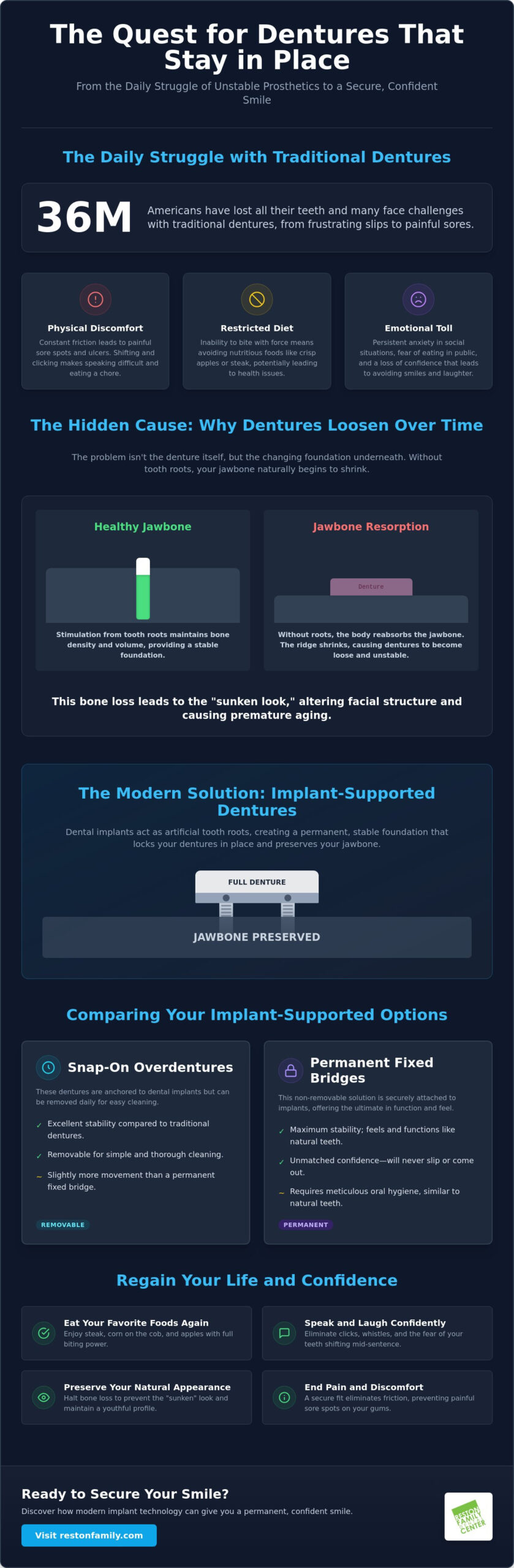
Traditional dentures are designed to sit atop the gums, held in place by a delicate seal of surface tension and suction. While this might work initially, the seal is notoriously unreliable because it relies on a perfect fit against soft tissue that is constantly changing. Without a mechanical connection to the jaw, the prosthetic is prone to shifting during basic movements like swallowing or yawning. For many, the dream of having dentures that stay in place feels like a distant memory as the prosthetic begins to “float” or click against the palate at the most inconvenient times.
This instability isn’t just a minor annoyance; it has tangible physical consequences. When teeth shift, speech becomes labored, often resulting in a whistling sound or slurred words. The constant friction between the acrylic base and the delicate gum tissue leads to painful sore spots or ulcers that make wearing the prosthetic unbearable. Physically, the inability to bite down with force forces many patients into a restricted diet. They avoid fibrous vegetables and proteins like steak, which can lead to nutritional deficiencies and a decline in overall health over time.
The Emotional Impact of an Unreliable Smile
The psychological toll of a loose denture is often heavier than the physical discomfort. Many patients report a persistent background noise of anxiety in social situations, constantly monitoring their mouth to ensure they have dentures that stay in place during a joke or a meal. This lack of security often leads to food fear, where individuals decline dinner invitations to avoid potential embarrassment. Over time, people may stop laughing or smiling openly, losing a vital part of their personality to denture insecurity. It’s a heavy emotional burden that impacts quality of life far beyond the dental chair.
When Adhesives Are No Longer Enough
The adhesive trap is a frustrating cycle where patients use increasingly large amounts of paste or strips to compensate for a poor fit. These products are temporary patches, not solutions. Many find that the chemicals in these adhesives leave a lingering metallic taste, interfering with the flavor of their favorite meals. The daily mess of application and the tedious process of scrubbing goo off the palate can become exhausting. Relying on these substances is often a biological signal that the underlying jawbone is changing. In clinical terms, a professional may recommend an Overdenture to provide a more stable foundation. When you find yourself reapplying adhesive multiple times a day, it’s a clear signal that the biology of your mouth has shifted, and a more permanent, high-tech solution is required.
The Jawbone Connection: Why Your Dentures Lose Their Fit Over Time
Many patients assume that if their prosthetic fits well on day one, it should stay that way forever. Unfortunately, the biological reality of tooth loss often interferes with this expectation. Jawbone resorption is the primary cause of denture instability. This process occurs because your jawbone requires constant stimulation to maintain its volume and density. When that stimulation disappears, the very foundation of your smile begins to change.
Bone resorption is the natural process where the jawbone shrinks and dissolves when it no longer supports tooth roots. Without the pressure of biting and chewing, your body perceives the bone tissue as unnecessary and begins to reabsorb the minerals. This change is exactly why dentures that stay in place eventually start to wobble or slip; the bony ridge they were designed to grip is literally disappearing. Traditional dentures can actually accelerate this loss by putting uneven, compressive pressure on the gums, which signals the bone to break down even faster.
The aesthetic result of this process is often referred to as the “sunken look.” As the jawbone loses height and width, the lower third of the face begins to collapse. You may notice your chin moving closer to your nose, your lips thinning, and deeper wrinkles forming around the corners of your mouth. This isn’t just a sign of aging. It’s a structural side effect of a shrinking foundation that traditional prosthetics cannot prevent.
The Role of Tooth Roots in Bone Health
Your natural tooth roots do more than just hold your teeth in place. They act as anchors that transmit biting forces into the jaw, signaling the body to keep the bone tissue dense and strong. Once those roots are extracted, the alveolar ridge begins to melt away. While relining your dentures every few years can help fill the new gaps, it’s merely a band-aid for a shrinking foundation. It doesn’t address the underlying biological need for root-like stimulation.
Preventing the “Sunken” Facial Appearance
Maintaining your bone height is essential for facial support and a youthful profile. Dental implants serve as “artificial roots” that halt the resorption process by providing the necessary stimulation the bone needs to stay healthy. When Comparing Your Options: Snap-On vs. Permanent Fixed Dentures, it’s clear that both paths offer significant bone-stabilizing benefits over traditional sets. By choosing a solution that integrates with your anatomy, you protect your facial structure for the long term. If you’re concerned about changes in your fit, we invite you to speak with our team about a personalized evaluation to see how we can restore your stability.
Implant-Supported Dentures: The Science of Stability
The shift from traditional prosthetics to implant-supported solutions represents a move from temporary surface adhesion to permanent mechanical integration. While we’ve discussed how bone loss undermines the fit of standard sets, dental implants solve this problem by acting as artificial tooth roots. These small titanium posts are surgically placed into the jawbone, creating a rock-solid foundation for dentures that stay in place regardless of what you’re eating or saying. By using the jawbone as a natural anchor, we eliminate the need for the suction or messy glues that traditional dentures require.
In our practice, we typically distinguish between standard implants and “mini” implants. Standard implants are the preferred choice for full-arch restoration because their larger surface area allows for maximum bone integration and support. Mini implants are sometimes an alternative for patients with significant bone loss who cannot undergo grafting; however, standard implants remain the gold standard for long-term durability and bite force. Our goal is always to provide the most stable and predictable outcome for your unique anatomy.
The Precision of 3D Digital Planning
Success in implant dentistry begins long before the day of your procedure. We utilize advanced 3D cone-beam CT scans to create a high-resolution map of your oral structures. This technology allows us to identify the densest areas of bone with sub-millimeter accuracy, ensuring each implant is placed in the optimal position for support. By using digital guided surgery, we can perform the procedure with incredible precision. This methodical planning translates to a faster recovery, less post-operative discomfort, and a prosthetic that aligns perfectly with your natural bite from the very first day.
Osseointegration: The Key to Permanent Support
The true magic of this technology lies in a biological process called osseointegration. Titanium is a highly biocompatible material, meaning your body doesn’t just tolerate it; it actually bonds with it. Over a period of several months, your natural jawbone grows into the microscopic threads of the implant post, essentially making it a part of your skeleton. This bond is what allows for dentures that stay in place even under significant pressure. Once this fusion is complete, you’ll experience a bite force that is nearly equal to that of natural teeth. This restorative journey requires patience during the healing phase, but the result is a level of reliability that traditional dentures simply cannot match. It’s a sophisticated marriage of biology and engineering designed to give you back your confidence.
This level of precision is common in modern Restorative and Cosmetic Dental Procedures, which prioritize both the biological health of the jaw and the aesthetic beauty of the final restoration.
Comparing Your Options: Snap-On vs. Permanent Fixed Dentures
Choosing the right path toward a stable smile depends on your lifestyle, budget, and long-term oral health goals. While both categories utilize dental implants to create dentures that stay in place, they differ significantly in how they are maintained and how they feel during daily use. Understanding these nuances helps you make an informed decision that aligns with your personal comfort and expectations.
The primary distinction lies in whether the prosthetic is removable by the patient or permanently attached to the implants. Both options provide a massive leap in function compared to traditional sets, but the biological and mechanical advantages vary. We take the time to evaluate your bone density and facial structure to recommend the system that will provide the most reliable results for your unique anatomy.
Snap-On Dentures: A Massive Upgrade from Traditional Sets
Snap-on dentures, also known as overdentures, represent a sophisticated middle ground for patients seeking better stability without the investment required for a fully fixed bridge. These prosthetics utilize “locator” attachments that click onto the implant posts, ensuring a secure fit that won’t shift during a meal or a conversation. For many patients in the Herndon or Vienna areas, this is an excellent value-driven choice that provides dentures that stay in place while remaining easy to manage.
The main benefit of a snap-on system is the ability to remove the denture at night. This allows for straightforward cleaning of both the prosthetic and the gum tissue around the implant sites. While they offer much more biting power than traditional sets, they do still have a slightly larger profile in the mouth to accommodate the attachment mechanisms.
Fixed Dentures (All-on-4): The Ultimate in Comfort
Fixed hybrid prostheses are often considered the gold standard for full-arch restoration. Unlike snap-ons, these are bolted directly onto the implants and can only be removed by a dental professional. This design allows us to eliminate the bulky acrylic that typically covers the roof of the mouth. Without that palate coverage, you can taste your food more clearly and speak with the same natural ease you had with your original teeth.
Because fixed dentures don’t move at all, they feel like a natural part of your body. You clean them just as you would natural teeth, using a toothbrush and specialized flossing tools. This option is ideal for candidates who want to forget they are wearing a prosthetic and return to a life of total “food freedom.” Ready to find your perfect fit? Schedule a consultation with our expert team to explore which implant-supported option is right for you.
When considering cost and longevity, fixed dentures generally have a higher upfront price but offer superior durability and bite force. Snap-ons are more affordable initially, though the attachment clips may need to be replaced every 12 to 18 months as they naturally wear down from the daily snapping action. Both options, however, provide the essential bone-stimulating benefits that keep your jaw healthy and your facial structure youthful.
Restoring Your Smile at Reston Family Dental Center
Choosing to move beyond the frustrations of loose prosthetics is a significant decision for your health and your confidence. At Reston Family Dental Center, we combine high-tech surgical precision with a warm, welcoming environment designed to make you feel at home. Our team understands that for many of the 36 million Americans living with total tooth loss, the desire for dentures that stay in place is about more than just mechanics; it’s about reclaiming a sense of normalcy and joy in everyday life. We treat every patient as an individual, ensuring your restorative journey is as comfortable as it is life-changing.
Our practice serves as a hub for advanced restorative care for neighbors from Ashburn to Great Falls. Because we maintain high-level in-house capabilities, you won’t have to bounce between different specialist offices to complete your treatment. From the initial diagnostic scans to the final fitting of your new teeth, you’ll remain with the team you already trust. This continuity of care ensures that every detail of your treatment plan is executed with the highest standard of accuracy and a gentle, human touch.
Your Journey to a Secure Smile: Step-by-Step
We believe that a well-informed patient is a confident patient. Your transformation follows a methodical, structured path to ensure long-term success and a result that feels entirely natural. The process includes:
- Initial Consultation: We begin with a comprehensive exam and digital 3D imaging. This high-resolution mapping allows us to evaluate your bone density and plan the exact placement of your implants before we ever begin the procedure.
- Customized Treatment Plan: Based on your goals and anatomy, we’ll help you choose between snap-on overdentures or fixed hybrid solutions. We take the time to explain the practical benefits of each path.
- Gentle Surgical Phase: Our experts place the titanium posts using guided surgery techniques. For those who feel nervous about the process, we offer advanced sedation options to ensure you remain relaxed and pain-free throughout the appointment.
- The Final Reveal: Once healing is complete and osseointegration has occurred, we fit your custom-crafted, permanent teeth. You’ll leave our office with a functional, beautiful smile that doesn’t require adhesives or second-guessing.
Why Northern Virginia Chooses Reston Family Dental Center
What sets our practice apart is the “Expert with a Heart” philosophy that guides every interaction. We use the latest innovations, like 3D imaging and biocompatible titanium, because they lead to better experiences for you. However, we never let the technology overshadow the person in the chair. We are deeply invested in the well-being of our community, providing a safe and reliable environment where high-level results and a pleasant experience go hand-in-hand. If you are tired of the slipping and clicking of traditional sets, we are here to provide the permanent stability you deserve. Schedule your denture consultation in Reston today!
Reclaim Your Confidence with a Permanent Smile
Living with a loose prosthetic doesn’t have to be your permanent reality. By understanding the biological link between tooth roots and jawbone health, you can make an informed choice to stop bone resorption and restore your facial structure. Whether you select the convenience of a snap-on overdenture or the seamless feel of a fixed bridge, the transition to dentures that stay in place represents a significant investment in your quality of life and long-term health. You no longer have to settle for the limitations of traditional adhesives or the anxiety of a shifting smile.
At Reston Family Dental Center, we prioritize your comfort through every stage of this journey. Our in-house implant specialists utilize advanced 3D digital imaging to ensure surgical precision, while our gentle sedation options provide a relaxing experience for even the most anxious patients. You deserve a smile that feels as natural as it looks, backed by a team that remains dedicated to your individual well-being and long-term success.
It is time to enjoy your favorite foods and speak with certainty once again. Book Your Secure Smile Consultation at Reston Family Dental Center to discover how modern technology can transform your life. We look forward to welcoming you into our practice and helping you achieve the secure, beautiful smile you have been waiting for.
Frequently Asked Questions
Will implant-supported dentures really stay in place while I eat?
Yes, implant-supported dentures remain completely stable while you eat even the most challenging foods. Because they are anchored directly into your jawbone, they provide a bite force that is nearly equal to that of your natural teeth. You won’t have to worry about your teeth shifting or clicking when you bite into a crisp apple or a piece of steak. This stability allows you to enjoy a diverse and nutritious diet without the fear of an embarrassing mishap.
How many implants are needed to hold a denture in place?
The number of implants required depends on whether you choose a removable or fixed solution. Typically, a snap-on overdenture requires 2 to 4 implants per arch to provide a secure fit. For a permanent, fixed bridge like the All-on-4 system, we usually place 4 to 6 implants to ensure maximum stability and support. During your consultation, we use 3D imaging to determine the exact number of anchors your unique bone structure requires for dentures that stay in place.
Is the surgery for implant dentures painful?
Most patients report that the procedure involves far less discomfort than they originally anticipated. We use local anesthesia to completely numb the area, and we offer gentle sedation options to help you remain relaxed and at ease throughout the appointment. After the procedure, any minor soreness is usually manageable with standard over-the-counter pain relief. Our team is dedicated to your comfort and will provide detailed aftercare instructions to ensure a smooth and peaceful recovery.
Can I use my existing dentures and have them converted to snap-ons?
It is sometimes possible to retrofit your current dentures to work with new implants, but this depends on the age and condition of the prosthetic. If your existing dentures are made of high-quality acrylic and are in excellent shape, we may be able to add the necessary “locator” attachments. However, many patients prefer a new, custom-crafted set that is specifically designed to take full advantage of the stability and aesthetics that modern implant technology provides.
How do I clean dentures that are permanently fixed in place?
You clean fixed implant dentures much like you would your natural teeth. Since they don’t come out at night, you’ll brush them twice daily with a soft-bristled toothbrush and non-abrasive paste. It’s also important to clean underneath the prosthetic using specialized tools like a water flosser or proxy brushes to keep the gum tissue healthy. Regular professional cleanings at our office remain essential to ensure your implants and the surrounding tissue stay in peak condition.
How long do implant-supported dentures last compared to traditional ones?
Implant posts are designed to be a permanent solution and can last a lifetime with proper care. The prosthetic teeth attached to them are highly durable and typically last 10 to 15 years before needing significant maintenance or replacement. In contrast, traditional dentures often need to be replaced or relined every 5 to 7 years. This is because traditional sets don’t stop bone loss, which causes the fit to deteriorate as your jawbone shrinks over time.
What is the recovery time after getting dentures that stay in place?
Initial healing of the gum tissue usually takes about one to two weeks, during which you’ll stick to a softer diet. The deeper biological process of osseointegration, where the bone bonds to the implants, typically takes three to six months. We often provide a temporary set of teeth during this phase so you never have to be without a smile. Once the bond is complete, we’ll place your final, high-strength dentures that stay in place for the long term.
Does insurance cover the cost of implant-supported dentures in Virginia?
Many dental insurance plans in Virginia classify implant-supported dentures as a “major” service. Coverage for these procedures typically ranges from 40% to 50% of the cost, though this is subject to your plan’s annual maximum and specific waiting periods. While every policy is different, our office staff is happy to help you navigate your benefits and explore financing options. We want to ensure that a secure, confident smile remains accessible and fits within your personal budget.