Second Opinions on Dental Work in Herndon
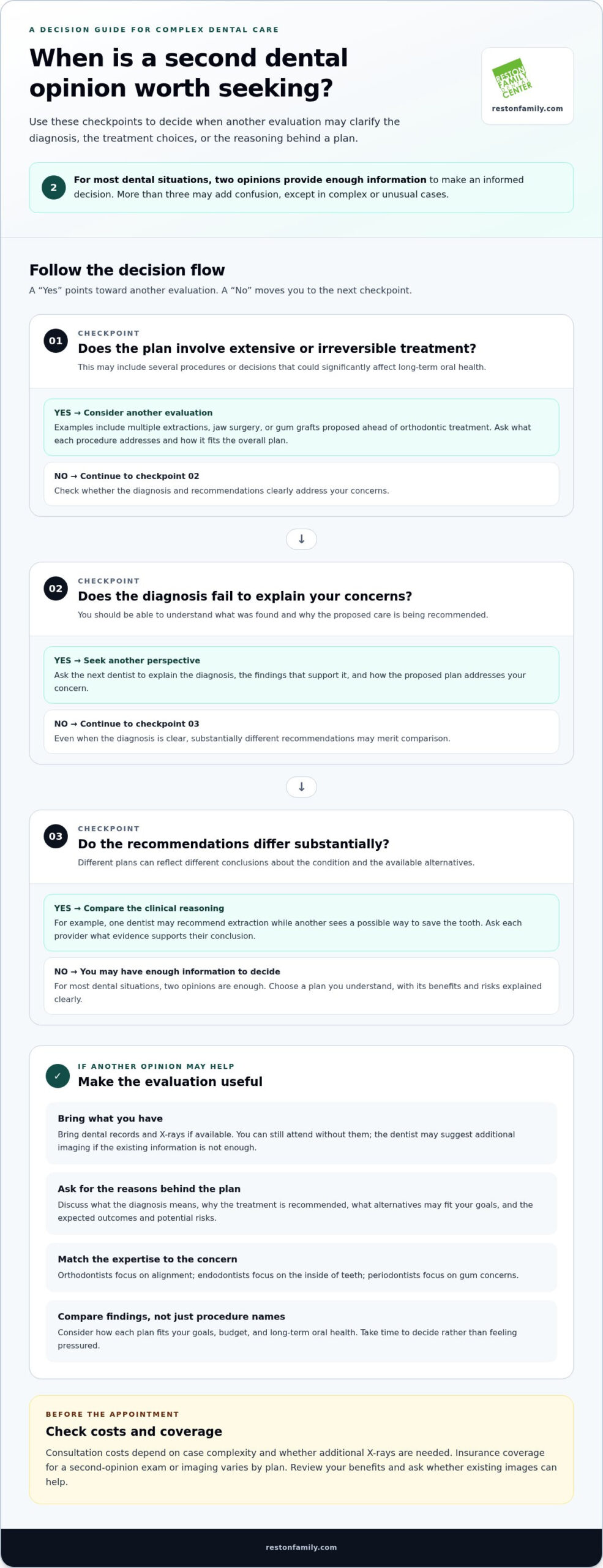
Complex dental work deserves careful consideration, and a second opinion on dental work in Herndon can help you understand your choices before deciding. For most dental situations, two opinions provide enough information to make an informed decision. Extensive treatment, a diagnosis that doesn’t fit your concerns, or substantially different recommendations are good reasons to seek another perspective.
It’s reasonable to want a clear explanation of what a proposed procedure involves, why it’s recommended, and what alternatives may suit your goals and oral health. A second opinion is an independent evaluation, not a commitment to proceed with treatment. This guide covers when another opinion may help, what to bring and expect, and how to assess differing recommendations so you can make an informed decision.
Key Takeaways
- Bring any available dental records or X-rays to help inform the review; a dentist may suggest additional imaging if needed.
- Ask for a clear explanation of the diagnosis, recommended treatment, expected outcomes, and potential risks so you can compare options.
- For extensive treatment or conflicting recommendations, focus on the clinical reasoning behind each plan before deciding what to do next.
- Dental insurance coverage for a second-opinion exam or X-rays varies by plan, so review your benefits before the appointment.
Complimentary dental second-opinion consultation
A second-opinion consultation gives you an independent evaluation of a diagnosis and proposed treatment. It can clarify your options and whether further imaging would help.
Consultation Questions and Expectations
Ask what the diagnosis means, why the recommended procedure is appropriate, and what alternatives may fit your goals. Request an explanation of expected outcomes and potential risks. For orthodontic concerns, ask how the recommendation addresses your bite, teeth, and jaw, and what the treatment plan involves. Orthodontists receive additional education and training focused on correcting misalignment.
Bring any dental records and X-rays you have; they can help the dentist assess the original findings. You can still attend without them. If the records do not provide enough detail, the dentist may recommend additional diagnostic tests or X-rays. This helps clarify what the existing evaluation shows and what still needs to be assessed.
For a concern requiring specialized expertise, seek an opinion from a dentist whose focus matches the issue. Orthodontists focus on alignment, endodontists on the inside of teeth, and periodontists on gum concerns. Matching the professional’s focus to your question can make the evaluation more useful.
Consultation Costs and Insurance Coverage
Second-opinion consultation costs depend on case complexity and whether additional X-rays are needed. The price depends on the case and is provided after a quote request; relevant factors include the evaluation and any additional imaging. Some offices may also charge a fee to copy records or X-rays.
Dental insurance coverage for a second-opinion exam or X-rays varies by plan. Before your appointment, review your benefits for consultation exams and imaging, as they may be covered differently. If the dentist recommends new X-rays, ask how they support the evaluation and whether existing images can help.
Should You Get a Second Opinion from a Dentist?
Consider another evaluation if a diagnosis does not explain your concerns or the recommendations differ substantially. A clear discussion can help you compare the reasoning and make an informed decision.
Discussing Another Opinion with Your Dentist
Tell your dentist you want clarity before deciding, and ask what findings support the recommendation. You might say, “I’d like another opinion so I can understand my options.” A dentist recommending significant treatment should be able to explain why it is needed. At your next appointment, describe your concerns and ask how the proposed plan addresses them.
For example, if a root canal or veneers have been recommended, ask what problem each treatment is meant to address. Request copies of your records and diagnosis to share at another evaluation. A referral does not obligate you to receive treatment from that provider, and you can consult an orthodontist without a referral.
Choosing a Second-Opinion Dentist
Match the dentist’s expertise to the treatment question. An orthodontist has additional education and training focused on correcting misaligned teeth, bites, and jaws. For a proposed root canal, ask whether the tooth can be treated and what alternatives may apply. The right fit depends on your concern, not simply the title.
Reviews can offer context, but don’t rely on them alone. Look for an explanation that connects the diagnosis, treatment plan, expected outcomes, and potential risks. If you’re weighing root canal care, a focused root canal evaluation can help clarify the clinical reasoning behind the recommendation.
Selecting a Dentist and Making a Final Decision
Compare each dentist’s findings and reasoning, not just the procedure names. Different plans may reflect your goals, budget, and long-term oral health. For example, one dentist may recommend extraction while another sees a possible way to save the tooth. Ask each provider to explain what evidence supports their conclusion before choosing.
For most dental situations, two opinions provide enough information to decide. More than three opinions may add confusion, except in complex or unusual cases. Choose a plan you understand, with benefits and risks explained clearly. Take time to consider your options rather than feeling pressured to decide quickly.
When complex dental work warrants another opinion
Extensive treatment plans deserve careful review, especially when they involve several procedures or irreversible decisions. A second opinion on dental work in Herndon can clarify the reasoning, compare alternatives, and help you find an approach that fits your oral health goals.
Consider another evaluation before multiple extractions, jaw surgery, or gum grafts are recommended ahead of orthodontic treatment. Ask what each procedure addresses and how it affects the overall plan. An orthodontist’s recommendation should explain the alignment concern and why those steps are proposed before braces or other orthodontic care begins.
A recommendation to remove a tooth is another reason to ask whether it can be saved. A root canal may suit some cases, while extraction may be appropriate in others. An independent evaluation can assess whether root canal treatment or another approach fits the tooth’s condition. Focus on the evidence for each option, not just the procedure names.
Complex restorative care can involve choices with different effects on long-term oral health. Ask how each treatment addresses the problem, what alternatives exist, and how your goals shape the decision. An advanced procedure is not automatically the best solution; its value depends on the diagnosis and intended outcome. Clear explanations can help you weigh extensive care thoughtfully.
If two dentists reach different conclusions, ask each to explain the findings and reasoning behind the recommendation. For instance, if one recommends extraction and an endodontist believes the tooth may be saved, another evaluation can help clarify the disagreement. A second opinion on dental work in Herndon lets you compare the clinical reasoning. Bring your records so the dentist can review the evidence and address your concerns.
Does dental insurance cover a second-opinion exam or X-rays?
Coverage for a second-opinion consultation, exam, or X-rays varies by dental insurance plan and provider. The plan’s benefits determine how these services are handled, so an exam and diagnostic imaging may have different coverage terms. Don’t assume the first dentist’s coverage decision applies to a separate evaluation.
Review your plan documents for benefits related to diagnostic exams and dental imaging. Note any limits or conditions that may apply to a second opinion. An appointment may involve an exam without new X-rays, or imaging may be recommended if the dentist needs more information. Coverage depends on your plan’s terms and the services performed.
Before booking, contact your insurer and ask whether a second-opinion exam is covered, whether X-rays are covered separately, and what information the office needs to submit. Keep the answers with your plan documents. If you already have recent dental records or images, bring them to the appointment; they may help the dentist evaluate the concern without duplicating information unnecessarily.
Patients in the United States may request copies of their dental records. Ask the original office for the records and X-rays you want considered, then share them with the dentist providing the new evaluation. If the images do not provide enough detail, additional diagnostic imaging may be recommended.
Clear coverage details can help you plan the visit and understand how insurance applies to each part. For help discussing your dental concerns and available care, contact the dental office.
Reston Family Dental Center: Dental Implants
Reston Family Dental Center provides dental implants for patients considering options for missing teeth. A second opinion can help you understand whether implants fit your oral health needs and goals, or whether another approach may suit you better. Implants are a long-term solution, but they are not the only way to replace missing teeth.
If you’re comparing recommendations for tooth replacement, discuss the evaluation and the reasoning behind each proposed plan. Reston Family Dental Center also provides implant-supported dentures and root canal therapy for different dental concerns. A clear review can help you understand the purpose of the recommended care and decide what questions to ask next.
Contact Reston Family Dental Center to discuss your dental concerns and next steps.
Move Forward With a Clear Plan
Your next step is to turn the evaluation into a decision that reflects your priorities. Write down your remaining questions, the outcome you want, and any concerns about treatment. A second opinion on dental work in Herndon can help you approach that conversation with a clearer understanding of your options.
If you’re deciding how to replace a missing tooth or whether a tooth can be saved, Reston Family Dental Center provides dental implants, implant-supported dentures, and root canal therapy. Bring your concerns to the conversation and focus on how the recommended care addresses them. You deserve to understand the path ahead without feeling rushed into a choice.
Contact Reston Family Dental Center to discuss your dental care and next steps. A thoughtful decision starts with the questions that matter to you.
Frequently Asked Questions
Can a second opinion confirm if I even need a root canal at all?
A second evaluation can assess whether root canal treatment suits the tooth’s condition or another option may be appropriate. The dentist considers the available findings and may recommend additional testing if more information is needed. If one recommendation is extraction and another is root canal treatment, ask each dentist to explain the evidence behind their proposed approach.
Do I need X-rays from my original dentist?
No, existing X-rays aren’t required to schedule a second opinion, but they can provide useful context. Patients in Reston, Great Falls, Ashburn, Chantilly, Herndon, and Vienna can request copies of their dental records to bring along. If the images do not provide enough detail, the dentist may recommend additional imaging. Records can help you avoid relying on memory alone.
How much does a second opinion consultation cost?
The consultation and imaging may be handled separately, so ask what the appointment includes before scheduling. Dental insurance coverage varies by plan. Review your benefits for consultation exams and X-rays to understand how each service is treated.
Is It Okay to Get a Second Opinion?
Yes, seeking another professional opinion is a reasonable way to understand a significant diagnosis or treatment recommendation. It can be especially useful when proposed care feels extensive, symptoms do not match the explanation, or dentists suggest different procedures. Use the evaluation to compare clinical reasoning and decide which plan addresses your oral health needs and personal goals.
Is it rude to ask for a second opinion?
No, asking for another opinion is a normal part of making a considered healthcare decision. You can tell your dentist you want to understand the diagnosis fully before proceeding. A direct, respectful explanation keeps the conversation clear: for example, say you value their recommendation but would like an independent evaluation. Your dentist should be able to explain the proposed treatment and its purpose.
What Are the Top Eight Signs It’s Time to Get Another Opinion?
Consider another evaluation if one or more of these situations apply:
- A treatment plan involves extensive work.
- Your symptoms don’t fit the diagnosis.
- Dentists recommend substantially different procedures.
- Extraction is advised, but saving the tooth is a concern.
- Orthodontic care includes multiple extractions or jaw surgery.
- You’re unsure whether a root canal is appropriate.
- Treatment costs exceed $3,000, a threshold the Consumer Guide to Dentistry highlights.
- You feel rushed before understanding the risks and alternatives.
These signs point to questions worth clarifying, not an automatic reason to reject treatment.